reality is only those delusions that we have in common...

Showing posts with label economics. Show all posts

Saturday, September 19, 2009

week ending Sept 19

OECD: Global Recession Over - Just thought everyone would want to know... From The Independent: OECD calls an end to the global recession - The OECD's composite leading indicators suggest that activity is now improving in all of the world's most significant 11 economies; the OECD agrees that unemployment will continue to rise into 2010...

not so fast: Global economic crisis to continue: IMF chief - (Reuters) The global economic crisis will continue and countries must do more to adopt financial market regulations, International Monetary Fund Managing Director Dominique Strauss-Kahn told a German magazine on Saturday.Strauss-Kahn said he wanted to see more action from nations to curb bankers' pay and tighten capital requirements in the banking sector.

Fed's Yellen: The Outlook for Recovery This is a long excerpt from CalculatedRisk, but worth reading ...full text: San Francisco Fed President Janet Yellen: The Outlook for Recovery in the U.S. Economy

Fed Paying Interest on Reserves: A Primer - The Federal Reserve used all the weaponry in its arsenal during the financial crisis, and created some new ones. The Treasury’s decision to pull back one innovation — in which the Treasury sold bonds and put the money on deposit at the Fed — has put the spotlight on another one... the Fed’s target for the fed funds rates is near zero and the banking system is awash with reserves. Many of those reserves aren’t being lent to other banks which can then use them to lend them to customers. Instead, they’re on deposit with the Fed. Until recently, the Fed didn’t pay interest on these reserves. Now it does...


Lending Is Taking a Dive, Oh My! - Yves Smith - Team Obama has taken to trumpeting the idea that the recession is over. The fact that we will see inventory restocking will produce a statistical recovery, at least in reported GDP. But US bank loans have fallen at an annual pace of almost 14pc in the three months to August (from $7,147bn to $6,886bn). “There has been nothing like this in the USA since the 1930s, The rapid destruction of money balances is madness.”

US credit shrinks at Great Depression rate prompting fears of double-dip recession - Both bank credit and the M3 money supply in the United States have been contracting at rates comparable to the onset of the Great Depression since early summer...US bank loans have fallen at an annual pace of almost 14pc in the three months to August (from $7,147bn to $6,886bn). The M3 "broad" money supply, watched as an early warning signal for the economy a year or so later, has been falling at a 5pc annual rate.

Bernanke: "Recession Is Over" (Depression Has Just Begun) - Again, I come back to the same point: Credit is contracting as a consequence of borrowing ABILITY, not (so much) desire. All the "liquidity pumping" in the world does NOTHING if there are no willing and able borrowers.

Economic Donkeys - Today, a year after global financial collapse and the ensuing tragedy for millions, our economic leaders are lining us up to suffer again (and again) through the same horrible experiences. The collapse of Lehman in September 2008 demonstrated just how far our economic system in general and bank management in particular have gone awry...

Which Crisis? - People are beginning to think that the worst of the crisis is behind us. But which crisis are they referring to? If they mean the financial crisis, they may be right. In fact, I would be surprised if the apocalyptic events of last fall did not mark a high point, of sorts. However, there's plenty more trouble to come...

The Japan syndrome - The Economist - THE recovery story is in full swing, with stockmarkets continuing to move higher on the back of improving economic data. But while many people hope the economy and markets are simply returning to normal, the potential parallels with Japan are still worrying...

Stiglitz Says Bank Problems Bigger Than Pre-Lehman (Bloomberg) -- Joseph Stiglitz, the Nobel Prize- winning economist, said the U.S. has failed to fix the underlying problems of its banking system after the credit crunch and the collapse of Lehman Brothers. “In the U.S. and many other countries, the too-big-to-fail banks have become even bigger,” Stiglitz said, “The problems are worse than they were in 2007 before the crisis.” Stiglitz’s views echo those of former Federal Reserve Chairman Paul Volcker...

"The Triumph of Central Banking?" - Paul Volcker discusses the usefulness of macroeconomic policy: Paul A. Volcker In Conversation with Gary H. Stern, Minneapolis Fed (pdf): ...Economic knowledge and central banking...

Volcker Sees ‘Long Slog’ for U.S. Economy, Seeks Bank Limits - (Bloomberg) -- Paul Volcker, the former Federal Reserve chairman who’s an economic adviser to President Barack Obama, said there’s a “long way to go” before the economy returns to pre-recession levels. “It will be a long slog -- a matter of years -- with the risk of some relapses along the way,”

Is Paul Volcker a liquidationist? - Economist - This is the view of recession as morality play, or as the hangover after the binge, and it's generally one that saltwater economists tend to reject. Paul Krugman wrote about this hangover theory thusly: The basic idea is that a recession, is somehow a necessary thing, part of the process of “adapting the structure of production.” We have to get those people who were pounding nails in Nevada into other places and occupation

Desperately seeking an exit strategy – Nouriel Roubini - the crucial policy issue ahead is how to time and sequence the exit strategy from this massive monetary and fiscal easing. Clearly, the current fiscal path being pursued in most advanced economies – the reliance of the United States, the euro zone, the United Kingdom, Japan and others on very large budget deficits and rapid accumulation of public debt – is unsustainable

Clearing skies over U.S. economy open rift at Fed - (Reuters) - An improving U.S. economy has exposed a widening rift at the Federal Reserve over how quickly to scale back the central bank's aid measures, a debate that will be front and center when policy-makers meet next week. Heightened prospects for a strong resurgence -- rather than the sluggish rebound many still envision -- have led some officials to worry an inordinate delay in scaling back the enormous support the Fed has given the economy could squander its inflation-fighting credibility.

The Continuing Disaster of Wall Street, One Year Later - Robert Reich - Let's be clear: The Street today is up to the same tricks it was playing before its near-death experience. Derivatives, derivatives of derivatives, fancy-dance trading schemes, high-risk bets. “Our model really never changed, we’ve said very consistently that our business model remained the same,” says Goldman Sach's CFO...

Too Big to Fail’ Is Dangerous, in Finance and Health Care – NYTimes - President Dwight D. Eisenhower warned of the birth of a military-industrial complex. Today we have a financial-regulatory complex, and it has meant a consolidation of power and privilege. We’ve created a class of politically protected “too big to fail” institutions, and the current proposals for regulatory reform further cement this notion...

In Shift, Wall Street Goes to Washington - As financial firms navigate a life more closely connected to government aid and oversight than ever before, they increasingly turn to Washington, closing a chasm that was previously far greater than the 228 miles separating the nation's political and financial capitals.

Where Politics Don’t Belong - NYTimes - FOR years now, many businesses and individuals in the United States have been relying on the power of government, rather than competition in the marketplace, to increase their wealth. This is politicization of the economy. It made the financial crisis much worse, and the trend is accelerating.

The Bailout Bill Comes Due, Vexing Agencies - The Federal Housing Administration, which is supporting the housing market by insuring loans for millions of struggling buyers, said Friday that its cash reserves had fallen below 2 percent for the first time. The Federal Deposit Insurance Corporation, meanwhile, is running out of money to pay back the depositors of failed banks. Taken together, the two developments indicate the limits of the government’s ability to make all the bad stuff go away...

Elizabeth Warren: Why Was Detroit Bailout Treated Differently Than Wall Street Bailout? - When car manufacturers in Detroit needed bailing out, Washington played hardball and made sweeping changes to the boards and management at both GM and Chrysler.Elizabeth Warren wants to know why two insolvent industries were treated so differently.Warren, chairwoman of the Congressional Oversight Panel, spoke with MSNBC (video incl)

For all Obama's talk of overhaul, the US has failed to wind in Wall Street - What went wrong? Have the right lessons been learned? Could it happen again? The anniversary of the freezing of the credit markets is an occasion for reflection. I fear that our collective response has been mistaken and inadequate – that we may just have made matters worse. The financial sector would like us to believe that if only the Federal Reserve and the Treasury had leapt to the rescue of Lehmans all would have been fine. Sheer nonsense...

Americans Have Been Taken Hostage - The American people have been taken hostage to a broken system. It is a system that remains in place to this day. A system where bank lobbyists have been spending in record numbers to make sure it stays that way. A system that corrupts the most basic principles of competition and fair play, principles upon which this country was built. It is a system that so far has forced the taxpayer to provide the banks with the use of $14 trillion from the Federal Reserve; a system partially built by the very people who currently advise our President, run our Treasury Department and are charged with its reform.

Fed Secretly "Stuffed" $500 Billion into "Foreign Private Pockets" and Gave $230 Billion to Citi "As a Secret Bailout" - we examined the Fed balance sheet and P&L statement only to find what looked like the Fed handing over half a trillion dollars to foreigners. This was very surprising! When I asked Chairman Bernanke if this was true, he said, “Yes.” When I asked him who got the money, he said, “Fourteen foreign Central Banks.” And when I asked to who did they give the money, he said, “I don’t know.” “I don’t know” is not good enough when you’re talking about $500 billion. That’s $1700 for every man, woman, and child in this country...

Ron Paul: "Goldman Sachs Has A Lot Of Influence In Our Treasury And A Lot Of Influence In Our Federal Reserve""[The Fed] is bigger than the Congress, [it] has more power than the Congress. The Fed Chairman probably is more powerful than our president, and yet we refuse to look at it. The time has come for us to look at the Fed"

So Much For High Frequency Trading - The Securities and Exchange Commission has proposed halting high frequency and flash trading. In response, Nasdaq (and others) are now prohibiting flash orders. Supposedly, the NYSE is also considering banning the practice. This was a given. The real question that remains unanswered and demands a thorough investigation is this: WHAT EXCHANGE OFFICIALS APPROVED THIS? WHO BELIEVED THAT ALLOWING FAVORED FIRMS TO FRONT RUN OTHER INVESTORS WAS OK?

A Short History of Fast Times on Wall Street - NYTimes - MANY fear that new technology is giving some investors unfair access to stock market information. Supercomputers allow certain traders to profit by executing trades in milliseconds, a practice known as high-frequency trading. These traders also use a technique called flash orders that gives them a sneak peek at other investors’ orders to buy and sell stock. This may seem like a 21st-century problem. But in fact, similar criticisms have been made for over 100 years...

Credit Swaps Lose Crisis Stigma as Confidence Returns – Bloomberg.com
(Bloomberg) -- A year after the bankruptcy of Lehman Brothers Holdings Inc., credit-default swaps have lost their stigma for disaster and are contributing to the growing confidence in the credit markets. The cost to protect against a failure by the biggest derivatives dealers dropped 66 percent in the past six months, according to an index of swaps compiled by Credit Derivatives Research LLC.

Financial Armageddon: I Admit It - I admit to thinking "I told you so" when I read the following article, "Derivatives Still Pose Huge Risk, Says BIS," from The Telegraph, in which those-in-the-know acknowledge that gross exposure, among other things, really does matter after all: "The global market for derivatives rebounded to $426 trillion in the second quarter as risk appetite returned, but the system remains unstable and prone to crises, according to the Bank for International Settlements (BIS)."

Maybe Securitization Didn't Cause The Crisis - Soon forthcoming in the top-ranked Quarterly Journal of Economics is a very well- received paper by four economists with convincing evidence of what many believe was the primary cause of the subprime boom and bust: That securitization took away the incentive for lenders to properly vet borrowers. But there's some new evidence questioning the paper's findings...

Wells Fargo's Ticking Time Bomb: Credit Default Swaps On Commercial MortgagesOutside experts hired by Wells Fargo to examine its books are reportedly shocked at the bank’s exposure to derivatives trades it took on when it acquired Wachovia may trigger huge losses at the bank, as per BankImplode.com It appears that Wachovia wrote credit default swaps on the junior tranches of commercial mortgage backed securities it was selling, which means that it is on the hook for losses in the riskiest CMBS tranches it sold. Wells itself might not even know the size of its exposure

Let them eat equity tranches - A curious proposal for securitisation reform has appeared in BIS’s latest quarterly review. The argument, so it goes, is that securitisation didn’t do so well in the recent financial crisis — structured financial products weren’t immune (or even that well protected) from losses in underlying collateral. Now that resecuritisation seems to be gaining pace, it might be a good idea to try to improve the process — that is, to try to “align the incentives” of those involved in securitisation

BIS Advises Higher Taxes For Big Banks - WSJ - Big banks' risks to the system increase more than proportionately with their size, and these financial giants should pay higher taxes to offset their potential threats to the system, a new study by the Bank for International Settlements says...

Fed Considers Bank Pay Limits - NYTimes— The Federal Reserve and the Treasury are preparing broad new rules that would force banks to rein in practices that made multimillionaires out of many financial executives during the housing bubble. The rules depart from the hands-off approach that dominated bank regulation for the last three decades, but are not as strict as proposals from some European leaders and suggestions from some members of Congress angered by the financial troubles of the last year.

The Federal Reserve contemplates compensation rules for banks -TIME - I was a little nonplussed this morning when I read the not-very-shocking WSJ article that came with the shocking headline, "Bankers Face Sweeping Curbs on Pay." What's happening is that the Federal Reserve is contemplating a rule that would allow bank examiners to veto compensation policies that they think encourage undue risk-taking...

Fed Plays Politics on Banker Pay - Yves Smith - The Wall Street Journal has a headline that would warm the cockles of any populist’s heart: “Bankers Face Sweeping Curbs on Pay.” And even more impressive, who is going to rein in banker compensation? The Fed. That alone should tell you there is less here than meets they eye. Let’s look at the outline of the idea...

Reforming the Financial System - Editorial - NYTimes - important work of regulatory reform remains undone. The proposed legislation that would bring most of the financial system under a regulatory umbrella, and impose higher capital requirements to cushion against losses. But in specific areas, like consumer protection, officials will have to fight to ensure that lawmakers do not water down the administration’s intent. In another area — the regulation of derivatives — Congress must improve the administration’s proposal...

The Hard Truth About Financial Regulation - Forbes - For all the talk and hand wringing $and billions in direct government equity stakes in major banks and loan and debt guarantees$ there's also been little real progress on how, or if, Washington might regulate its way out of this kind of mess in the future. Don't expect that to change anytime soon, as markets become more, not less, complex and interconnected...

But Who Is Watching the Regulators? - NYTimes - Senior regulators who stood idly by for years as financial firms built their houses of cards have been rewarded with even bigger jobs or are jockeying for increased responsibilities. The Federal Reserve Board, for example, wants to become the financial system’s uber-regulator, even though its officials did nothing as banks made deadly decisions to lend recklessly and leverage themselves to the max...

Why a meltdown could happen again -What have President Barack Obama and Congress done to prevent them from doing it to us again? Pretty much what Obama did when he spoke to Wall Street earlier this week. Talk. "They really haven't done anything that could prevent another meltdown," says Joseph Mason, a financial-sector expert who used to work for one of the main national banking regulators, the Office of the Comptroller of the Currency...

Text of Obama’s Financial Speech - SF Fed - Presentation to the San Francisco Society of Certified Financial Analysts on Monday

Why Didn’t The Major Bank CEOs Show Up On Monday? - Baseline Scenario - More than any technical discussion of raising capital standards or tightening leverage ratios, this presumably uncoordinated failure to show up speaks volumes about current attitudes on Wall Street. The CEOs of our biggest banks have weighed the man and done the trade. They have no more use for this President, and see no reason to show support. They have moved on – presumably back to whatever they were doing before...

Too-Big Banks Can Take Comfort in Obama’s Math (Bloomberg) -- President Barack Obama did Americans a great service yesterday. He boiled down what’s wrong with his administration’s approach to the financial crisis into a single, symbolic statistic. Let’s be clear: Taxpayers have not earned a 17 percent return on the bailout. Real-life investors don’t count only their winners. It is clear that, despite the rhetoric, the reforms will be timid and that the time has passed for true reform with other policy items now taking star billing

Why Wall Street Reforms Have Stalled - NY Times Debate Forum - commentary on why it’s so hard to regulate Wall Street from seven finance talking heads

John Hempton: Vested self interest and the future of Fannie Mae and Freddie Mac
- Wall Street always hated Fannie and Freddie taking interest rate risk – it encroached on the profitability of Wall Street trading desks. Trading interest rate risk is the core business of Wall Street trading desks – and they hated having GSEs (with funding advantages) crowding them out of their own game. But Wall Street loved Fannie and Freddie taking credit risk – that meant that Wall Street could splice and dice mortgages all they like – and know that eventually Uncle Sam will pick up any credit losses.

Reforming Banking by Reforming Housing - Like heart disease, there may be many different significant risk factors for banking crises. However, the evidence to date suggests that real estate volatility is one of the most important, if not the most important. Reducing the risk of future crises (and their drain on the public treasury) requires that something be done to address this risk factor...

Regulation in Defense of Capitalism - Will regulation hobble capitalism? I think the opposite is true. Properly done, government regulation of the financial industry will move the industry closer to the capitalist ideal. By capitalism, I mean where those who take the risks and put up the money get the fruits of their labor. And, importantly, where those who take the risks and put up the money actually do take the risks, bearing the full costs of failure as well as success.

Why capitalism fails - if Minsky was as right as he seems to have been, the news is not exactly encouraging. He believed in capitalism, but also believed it had almost a genetic weakness. Modern finance, he argued, was far from the stabilizing force that mainstream economics portrayed: rather, it was a system that created the illusion of stability while simultaneously creating the conditions for an inevitable and dramatic collapse.

The Origin of Development as Cover for Imperialism and Racism - The British feared that non-white people in the colonies might side with the Japanese rather than their colonial masters. The British had to come up with a new justification for colonial rule to replace the unpopular and increasingly implausible idea that they were a superior race destined to rule inferior races. In response, they invented the concept of economic development.

The Imperial Origins of State-Led Development - Globalization protesters routinely link American imperialism to promotion of capitalism overseas. For example, Naomi Klein’s 2008 book The Shock Doctrine: The Rise of Disaster Capitalism draws a vivid connection between American interventions overseas (like the CIA overthrowing Allende in Chile, or today’s Iraq) and the promotion of free markets (“neoliberal economics”).

Why the corporation? - Recently I posted about C. Wright Mills and his analysis of power elites in America (post). A major theme in Mills's book is the new power associated with the American corporation following World War II. Charles Perrow's Organizing America: Wealth, Power, and the Origins of Corporate Capitalism (2002) offers an historical account of how this system of power came into being. The topic is particularly relevant today, when the Supreme Court is considering whether "corporations have a right to free speech", and therefore a right to further deepen their influence on political directions and policies through their funding of political messages.

Ben Bernanke and the Missing $165 Large - $165 large (billion) is missing from the economy, or soon may be, about 1.2 percent of GDP including the vig, and Ben Bernanke knows the whereabouts, or, rather, the where-it-isn'ts. We're referring, of course, to the Federal Reserve's Consumer Credit Report, the July G.19 released today, which shows a seventh consecutive monthly decline in revolving charge card balances, the longest pay-down streak seen since a similar stretch in 1980. Now charge-card credit is falling at an 8.0 percent pace, seasonally adjusted...

Charging People For Not Having Enough Money Is Big Business - By not warning customers that they're close to running out of money, and just letting them run out of money, banks are making a lot of money -- charging people for not having enough money. The New York Times reports that "this year alone, banks are expected to bring in $27 billion by covering overdrafts on checking accounts, typically on debit card purchases or checks that exceed a customer’s balance. In fact, banks now make more covering overdrafts than they do on penalty fees from credit cards."

The giant sucking sound of US private sector credit contraction - Private sector deleveraging accelerated fairly dramatically in Q2, even as financial market conditions were showing material improvement. Private sector credit contracted by $2.32 trn at an annul rate after shrinking $1.84trn in Q1. This is an unprecedented event in the postwar period and highlights the fragility of the recent recovery.

U.S. Credit-Card Defaults Resume Ascent as Unemployment Worsens - Bloomberg.com(Bloomberg) - The biggest U.S. credit- card lenders said defaults climbed in August as the unemployment rate jumped and the impact of tax refunds waned. The industry’s data may signal that the second quarter’s improvement will be short-lived as tax refunds and federal efforts to stimulate the economy run out. Defaults tend to track the jobless rate...

Adviser: High Unemployment For Years - The president’s chief economic adviser warned Friday that the nation’s unemployment rate could stay “unacceptably high” for years to come — a situation that would seriously complicate Barack Obama’s ability to convince Americans that he’s beating back the recession.“The level of unemployment is unacceptably high,” Larry Summers said Friday. “And will, by all forecasts, remain unacceptably high for a number of years.”

Manpower Employment Outlook Survey: No Respite In Sight - When seasonal variations are removed from the data, the results suggest that employers expect a slight decrease in the rate of hiring when compared to Quarter 3 2009. The fourth quarter Net Employment Outlook for the U.S. is considerably weaker than one year ago at this time.

New York Faces Dramatic Consequences of Crisis - Der Spiegel - The global financial crisis began in Manhattan, and its effects are being felt far more strongly there than elsewhere. Mayor Michael Bloomberg says the situation is critical. Millions are fighting to keep their jobs. Is what is happening in New York today a harbinger of the fate of the rest of the world?

As Jobs Are Lost in Recession, So Is the Middle Class - Across the United States a sense has taken hold that the Great Recession and the financial crisis are predominantly a result of national profligacy, yet that is only part of the explanation. Many have lived beyond their incomes simply because incomes have been outstripped by the costs of middle-class life. “For middle- and low-wage workers, the median wage basically went nowhere over these years.

How about those jobless claims? - The Economist - THEY'RE still high. News outlets may trumpet that they feel by more than expected, to 545,000, but the numbers continue to be where they've been, more or less, since the beginning of July. That's nearly three months with no significant improvement. As usual, Calculated Risk has the helpful chart

Nearly Half Of US Households Hit By Job Losses Or Pay Cuts - Nearly half the country has had a pay cut or job loss in the last year, according to a new poll from the Washington Post and ABC News. A shocking 41 percent say that in the last year someone in their household has had their pay or work hours cut. Twenty-seven percent say someone in their home has been laid off or lost their job.

Fed: Household Net Worth Off $12.2 Trillion From Peak - The Fed released the Q2 2009 Flow of Funds report today: Flow of Funds. According to the Fed, household net worth is now off $12.2 Trillion from the peak in 2007. (graph) This is the Households and Nonprofit net worth as a percent of GDP.

The Poverty Rate Is Vastly Understated - Very little to add to this story, other than the official definition of poverty by government statisticians borders on criminal. Either this figure has never been indexed to inflation, or government workers have never lived life in the real world paying for basics such as shelter or food. Obviously the true numbers (and percent) of Americans living in poverty is much higher than below - but whatever the actual number, this economy is not working for a great many.

Economic Inequality: The Wall Street Journal is Just Wrong - The Wall Street Journal front page story last week was shocking. It’s use of bad data was a misuse of this important forum. In effect, the article says that economic inequality was never really a problem, and even if it is we no longer have to worry about it. These conclusions are just plain wrong.The Journal article effectively leads the reader to two conclusions: First, any issues that may exist around economic inequality are disappearing, because of the likely decline in the outsize incomes of the top 1% of Americans, those with a minimum income of $400,000. Second, the problem was never really that bad in the first place

Wrongheaded and Incomplete on Incomes - This morning’s page-one Wall Street Journal story on incomes in America contains many bungled facts and concepts in a single sentence, giving a false impression about income distribution in America. The piece follows the curious look at the fortunes of the rich published August 20 by The New York Times...These reports display a puzzling sympathy for the best-off in America...

Press Accuracy Rating Hits Two Decade Low: Overview - Pew Research - (surveys, graphs, tables) - Just 29% of Americans say that news organizations generally get the facts straight, while 63% say that news stories are often inaccurate. Similarly, only about a quarter (26%) now say that news organizations are careful that their reporting is not politically biased, compared with 60% who say news organizations are politically biased. And the percentages saying that news organizations are independent of powerful people and organizations (20%) or are willing to admit their mistakes (21%) now also match all-time lows.

Annual Decline In CNBC Viewership Accelerates: Down 37% In Overall Viewers Category - CNBC continues to bleed vierwers. Whereas the last time we provided an update of CNBC's vierewship as measured by Nielsen, the GE subsidiary was down 28% YoY, the September decline is even more pronounced: at a 37% decline in total viewers and a 26% decline in the 25-54 demographic.

Reducing media bias through regulation - VoxEU - Is there a crisis in the media and journalism? This column alleges that advertising has seriously interfered with the quality, accuracy, and breadth of content and programming in the media. It calls for vigorous competition in media markets and public funding of informative media as a public good.

Will Obama, Fed tolerate another jobless recovery? - As the economy begins to grow again, the nation faces a huge challenge: Consumers drive roughly 70 percent of U.S. economic activity, but job growth is expected to be quite slow even as the recovery gains steam. Think of it as America's chicken-and-egg dilemma: The economy needs a big jump in consumer spending to spur exceptional growth, but that won't happen as long as unemployment remains high.

Consumer spending on the mend? - There is some evidence out there that consumer spending has dropped so low, that with confidence anew (see national Consumer Confidence and Sentiment surveys), consumers are taking baby steps back into the spending picture. According to Gallup, consumers spent and average $66/day on 9/13/09, up from $59/day at the end of August.(w/ chart of 14-day moving average)

Quick Note on Confidence - As Calculated Risk noted, the commentary on the August Consumer Sentiment number from the University of Michigan ran along the generally positive tone echoed by the Wall Street Journal. Looking at a charts, it is tough to see much of a rebound in August; the bounce happened in April, and the index has been moving sideways since: (charts follow)

Someone Is Lying - The most recent reading of the increasignly unreliable UMichigan Consumer Confidence index was recently at multiyear highs, yet today the ABC Consumer Index turned down yet again. The most recent reading was -49, a one point reduction from -48 in the prior week, and below the SM Average of -48.57. Not surprisingly, this week 43% of Americans feel the economy is getting worse, up 12% from last month!

A confession from a home ownership advocate - The game of finding someone to pin the blame on for the US housing market collapse has gone on long enough. Are the bankers responsible? The analysts who didn’t see it coming? The McMansion mums who bought homes that they couldn’t afford? No. I did it. It was me. In 2003, I worked for one of those well-meaning organisations that promoted home ownership in low-income communities.

Lehman is a footnote in the great East-West globalisation crisis - As of last week, the ABX index of sub-prime mortgage debt showed that AAA-rated securities from early 2007 were trading at 28 cents on the dollar – AA was at 4 cents, near all-time lows. No one can say that $2 trillion (£1.2 trillion) of sub-prime and Alt-A debt is still trading at panic levels, exaggerating losses. The dust has settled. What we can see is that creditors will never recoup their money.

Homeowners who 'strategically default' on loans a growing problem - Who is more likely to walk away from a house and a mortgage -- a person with super-prime credit scores or someone with lower scores? Research using a massive sample of 24 million individual credit files has found that homeowners with high scores when they apply for a loan are 50% more likely to "strategically default" -- abruptly and intentionally pull the plug and abandon the mortgage -- compared with lower-scoring borrowers.

"Option" mortgages to explode, officials warn (Reuters) - The federal government and states are girding themselves for the next foreclosure crisis in the country's housing downturn: payment option adjustable rate mortgages that are beginning to reset. "Payment option ARMs are about to explode," Iowa Attorney General Tom Miller said after a meeting with members of President Barack Obama's administration. Option-ARMs are now considered among the riskiest offered during the recent housing boom and have left many borrowers owing more than their homes are worth.

The Credit Score Impact of Mortgage Choices ... short sales can trigger big drops in credit scores. ... strategic defaults [lead to even larger credit hits] "plus negative marks on their credit bureau files for as long as seven years." ... People who file for bankruptcy protection covering all their debts (mortgage, credit cards, auto loans, etc.) will get hit [the hardest]. Bankruptcies remain on borrowers' credit bureau files for 10 years.

More on Housing Tax Credit - From Bloomberg: Homebuyer Tax-Credit Extension Gains Lawmaker Support - An extension of the $8,000 U.S. homebuyer tax credit is gaining support in the Senate as bill sponsor John Isakson said he is rallying lawmakers to continue a program that helped boost home sales by more than 1 million.
This is terrible policy, and hopefully the bill will be scuttled.

The Housing Tax Credit Debate - From David Streitfeld at the NY Times: Fight Looming on Tax Break to Buy Houses. Streitfeld discusses some of the proponents of extending and expanding the tax credit (like the NAR), and some of the opponents (most economists on the right and left. Mark Zandi at Economy.com supports extending and expanding the tax credit because he believes the housing market is still in serious trouble. But if we actually look at the numbers, this is a poor choice for a second stimulus package....

BlackRock’s Fink Says Obama Loan Rules Threaten Mortgage Market (Bloomberg) -- BlackRock Inc. Chairman Laurence Fink said Obama administration programs to help homeowners stave off foreclosure may hinder the recovery of the mortgage market while benefiting banks that own second loans on the properties.

The Impact on Mortgage Rates of the Fed buying MBS - The Federal Reserve released the Factors Affecting Reserve Balances today. Total assets were basically flat at $2.14 trillion. This graph from the Atlanta Fed shows the breakdown in the assets. This raises an interesting question: What is the impact from Fed MBS buying on mortgage rates?

FTC Considers Total Ban on Upfront Loan Modification Fees. - The head of the Federal Trade Commission said Thursday the agency is considering banning upfront payments to companies that advertise help for borrowers who are in trouble on their home loans. Government officials say scammers seeking to take advantage of borrowers in danger of default often charge upfront fees of $1,000 to $3,000 for help with loan modifications that rarely, if ever, pay off.

Unable To Sell Their Houses, Millions Of Homeowners Are Turning Into Landlordsmaybe - Since 2007 about 2.5 million homes have been converted into rentals, according to an analysis performed for The Huffington Post by Foresight Analytics, a real estate market research firm. The conversions account for about 85 percent of the increase in rental homes.

Fed Reviewing Banks' Commercial Real Estate Exposure (CNBC) The Federal Reserve is involved a broad review of commercial real estate exposures at the nation's largest regional banks, which Fed sources say is both the result of concern in that area but part of the "new normal" for how they will be supervising banks...People familiar with the examinations say the fed is "getting granular" looking, for example, at the differences in banks' concentration of construction loans vs. multifamily vs. motels and retail.

Quelle Surprise! Regulators Starting to Worry Re Bank Commercial Real Estate Exposures - Yves Smith - Apollo Management, which is a very savvy real estate player, warned of a coming “black hole” in commercial real estate six months ago. - US bank regulators seem to be taking warnings of his sort seriously only now. The Fed is poking its nose into the portfolios of some banks, oddly taking great care to say these are NOT stress tests...

Another Year, Another Decline in Employer-Based Coverage - Ezra Klein shows the new Census figures on the uninsured. The long-term trend is absolutely clear: employer-based coverage is declining and public coverage is increasing, but not enough to make up the gap. Looking at the underlying data, we can see that 2008 was the eighth consecutive year in which the proportion of people covered by employer-based health insurance declined.

A Modern Safety Net - The Great Recession has revealed that our social safety net--primarily established by Franklin D. Roosevelt during the Great Depression--is more hole than net...the fundamental income-support programs for those in need--unemployment insurance, cash welfare through the Temporary Assistance for Needy Families (TANF) program, and food assistance through the Supplemental Nutrition Assistance Program (SNAP, formerly food stamps)--have been off the front burner in the policy debate and are in need of reforms

Closing The Book On The Bush Legacy - On every major measurement, the Census Bureau report shows that the country lost ground during Bush's two terms. While Bush was in office, the median household income declined, poverty increased, childhood poverty increased even more, and the number of Americans without health insurance spiked.

The Wild Card - NYTimes - there’s a wild card out there undermining the chances for real reform, and it’s not the crazies who have been disrupting health care forums. It’s the ordinary working men and women of America who are struggling with the worst economic downturn they have ever seen and who are worried that the big new plans that the Democrats have in store may not be in their best interests — and may not be affordable.

How Does the NYT Know that Republicans Are Opposed to a Public Health Insurance Option: “Because They Are Worried About the Costly Commitments Undertaken by the Government to Stave Off Economic Collapse?" - This is certainly a more politically appealing line then saying that they oppose a public option because of their close ties to the insurance industry. Since the NYT does not know the real reason that Republican members of Congress oppose a public option, it should refrain from making assertions about their reasons, and simply report what they say.

Kung Fu Monkey: I Miss Republicans. - No, seriously. Remember Republicans? Sober men in suits, pipes, who'd nod thoughtfully over their latest tract on market-driven fiscal conservatism while grinding out the numbers on rocket science. Remember those serious-looking 1950's-1960's science guys in the movies - Republican to a one. They were the grown-ups. They were the realists. How did they become the party of fairy dust and make believe? How did they become the anti-science guys? The anti-fact guys? The anti-logic guys?

Dem Senator Warns of 'Big, Big Tax' on Middle Class in Baucus Bill - It's not every day that you hear a Democratic senator charge that a fellow Democrat is proposing to raise taxes on the middle class, but that is what happened when Sen. Jay Rockefeller, D-W.Va., ripped into the health-care bill developed by Sen. Max Baucus, D-Mt The Baucus proposal would impose, starting in 2013, a 35 percent excise tax on insurance companies for "high-cost plans" -- defined as those above $8,000 for individuals and $21,000 for family plans.

Baucus and the Threshold, by Paul Krugman - NYTimes - ... whatever health-care bill finally emerges will fall far short of reformers’ hopes. Yet even a bad bill could be much better than nothing. ... How bad does a bill have to be to make it too bad to vote for?

International Health Care Spending Comparisons - re: business week table - the analysis is flawed. Note it is in terms of Purchasing Power Parity (PPP)...it could mean that spending in the domestic currency was unchanged and the exchange rate used to calculate it in PPP terms changed... Because of this these growth rate comparisons are meaningless.

Unhealthy men ‘may lose 10 years’ - BBC - Middle-aged male smokers with high blood pressure and raised cholesterol levels face dying about 10 years before healthier counterparts, a study warns. The UK study looked at more than 19,000 civil servants aged 40-69 and traced what happened to them 38 years later

Lack of insurance causes more than 44,000 U.S. deaths annually - SciAm - Going without health insurance can delay when people obtain primary and preventative care, potentially resulting in poorer health. Even more gravely, a lack of private health insurance brings an increased risk of death; uninsurance is to blame for some 44,789 adult deaths across the U.S. every year, according to a new study published online today in the American Journal of Public Health

Physician Views on the Public Health Insurance Option and Medicare Expansions - RWJFA RWJF survey summarized in the September 14, 2009 edition of the New England Journal of Medicine shows that 62.9 percent of physicians nationwide support proposals to expand health care coverage that include both public and private insurance options

Birthers, Deathers and Truthers - the reason behind the madness - Birthers believe Barack Obama's birth certificate was faked. Deathers believe Obama's health care reform bill is Soylent Green in disguise. Truthers believe the 9/11 attack was an inside job So should we mock the weak, or, with greater wisdom, accept that Reason is a hard road that few follow? I would say neither. I have had the opportunity to observe someone with a quite low IQ be right when I am wrong...

The Recession’s Racial Divide – NYTimes - What do you get when you combine the worst economic downturn since the Depression with the first black president? A surge of white racial resentment, loosely disguised as a populist revolt…An article on the Fox News Web site has put forth the theory that health reform is a stealth version of reparations for slavery: whites will foot the bill and, by some undisclosed mechanism, blacks will get all the care. President Obama, in such fantasies, is depicted as a befeathered African witch doctor with little tusks coming out of his nostrils.

The Return of the Repressed - Now that popular conservatism has given itself over so avidly to racial resentment, it's curious to remember how hard the right once tried to scrub itself of the lingering taint of prejudice. Indeed, for a decade and a half the Christian right -- until recently the most powerful and visible grassroots conservative movement -- struggled mightily to escape its own bigoted history...

Barack Obama Does Something Really Stupid: Tire Tariffs - Let's see... 250 million cars in America... need 4 tires per car... need new tires every 2.5 years. 400 million tires a year... $1.4 billion dollars a year... 10,000 worker jobs saved... $140,000 dollars per worker-job per year.Looks like we could (a) let the Chinese sell us tires, (b) tax each tire by $2.50, (c) pay each tire worker who loses his or her job $100K a year, and we come out ahead: American households have more money to spend on other things, China has more jobs to help what is still a very poor country grow, and tire workers have higher incomes and more leisure as well.

China Investigating U.S. Exports - NYTimes - China unexpectedly increased pressure Sunday on the United States in a widening trade dispute, taking the first steps toward imposing tariffs on American exports of automotive products and chicken meat in retaliation for President Obama’s decision late Friday to levy tariffs on tires from China. The Chinese government’s strong countermove followed a weekend of nationalistic vitriol against the United States on Chinese Web sites in response to the tire tariff.

Tire tariffs and the general cluenessness of the New York Times - China’s response is only unexpected if you know nothing about international trade and Chinese politics. The Chinese response is perfectly expected if you have the slightest idea of what is going on. What would you expect the Chinese government to do, hug and kiss the US trade negotiators and heap love and praise on them. Thank you, thank you, thank you for imposing tire tariffs. Sheesssshhh.

US tyre duties spark clash - Financial Times - A full-blown trade row erupted between the US and China after Beijing accused Washington of “rampant protectionism” for imposing heavy duties on imported Chinese tyres and threatened action against imports of US poultry and vehicles. Trade relations between two of the world’s biggest economies deteriorated after Barack Obama, US president, signed an order late on Friday to impose a new duty of 35 per cent on Chinese tyre imports on top of an existing 4 per cent tariff.

China Reacts Quickly and Badly to Tire Tariffs - Yves Smith - when the US imposed stiff tariffs on imported tires from China late on Friday, we noted, “This could get interesting in a bad way.” The Chinese responded quickly over the weekend to announce they were investigating US auto parts and chicken, which together account for roughly as much as the disputed tires ($1.2 billion versus $1.3 billion for tires). The Financial Times branded the harsh reaction from China as elevating the US action to “a full-blown trade row.”

China scorns focus on imbalances - "China – which reacted angrily to US moves to slap countervailing duties on tyre imports this week – wants the G20 to make a strong commitment to avoiding protectionism…US officials see co-ordinated efforts to reduce global imbalances as essential to underpin the recovery from the global recession and ensure the future pattern of global growth does not rely on bubble-fuelled spending in the US."

an editorial from the Economist: Barack Obama does a bad thing - THIS is not good. Not good at all....while the direct effects of the move are sufficient to move the tariffs into bad idea territory, the loss from the tire tariff is small relative to the potential loss of a series of retaliatory measures from both countries.

Economists React: China Tariff “Disappointing” and Timing “Unfortunate” - WSJ - capsule comments from several blogs, with links to the blog articles...

FT.com – Obama’s decision on tariffs is calculated cynicism - "The US may import fewer tyres from China, but this decision is not going to jumpstart moribund domestic tyre production. This is protectionism without the protection...

Behind the scenes with China and America - The Economist - "China scrupulously avoids using its Treasury holdings to air such frustrations. The risk of self-sabotage is simply too great, especially as its pile of Treasuries has grown: Even a couple-percentage-point loss on a trillion-dollar portfolio translates to tens of billions of dollars."

Murder-Suicide in Chimerica - With this trade war looming, one must wonder if Chimerica, the marriage of China and America as one economic entity, will end in murder-suicide, taking the global economy down with it. I now see a trade war between China and the United States as the biggest threat to global economic recovery.

The “noodle bowl” of free trade agreements in East Asia - Vox EU - East Asian economies adopted numerous preferential trade agreements over the last decade. This column summarises the results of a survey of firms in the region examining the effects of those trade deals. The region’s exporting manufacturers largely view trade preferences positively, though further policy action is needed to maximise the potential benefits.

Revealed: The ghost fleet of the recession on a sleepy stretch of shoreline at the far end of Asia, is surely the biggest and most secretive gathering of ships in maritime history. Their numbers are equivalent to the entire British and American navies combined; their tonnage is far greater. Container ships, bulk carriers, oil tankers - all should be steaming fully laden between China, Britain, Europe and the US. Never before photographed, it is has no crew, no cargo and no destination. (incl. satellite photos and more)

What’s “Hot” and What’s Not, in International Money - China during the years 2004-2008 was pretty much the first large country to face charges of unfairly manipulating its currency to keep it undervalued. But US Congressmen who have for years urged China to abandon its link to the dollar could well live to regret it, if they were to get their way and the People’s Bank of China did in fact stop buying US treasury bills...

Peking Over Our Shoulder - Our Chinese shareholders get nosy - The Chinese bureaucrats at his table mostly wanted to know about health care reform. "They were intrigued by the most recent legislative developments," Orszag says. "It was like, 'You're fresh from the field, what can you tell us?' " As it happens, health care is much on the minds of the Chinese these days. Over the last few years, as China has become the world's largest purchaser of Treasury bonds, the government has grown increasingly sophisticated in its understanding of U.S. budget deficits.

China’s recovery starts to accelerate - FT -China’s economy showed fresh signs on Friday that its recovery was gathering pace, with data showing that investment, industrial output and credit all expanded more rapidly in August, although the government still believes it is too soon to begin tightening policy.

China Will Be an Even Bigger Bubble Than Japan - the Chinese economy has many similarities to the Japanese economy before it imploded in the 90’s. 8 reasons why the Chinese economy is likely to be an even larger implosion than the Japanese economy...

China to world: No more shiny metals for you - China may ban export of gold, silverLast week Alan Greenspan noted that “Rising prices of precious metals and other commodities are an indication of a very early stage of an endeavor to move away from paper currencies.” In other words, people are buying gold as a hedge against inflation.

Nicolas Sarkozy wants ‘well-being’ measure to replace GDP – Telegraph - Nicolas Sarkozy, the French President, has called on politicians to ditch GDP as a measure of national wealth and replace it with one that quantifies well-being alongside economic strength Speaking at the launch of a report he commissioned from Nobel Prize winning economist Joseph Stiglitz , President Sarkozy said France would pioneer the new technique and urge other countries to follow suit.

Towards a better measure of well-being - FT -A political leader will be graded on economic performance but there are many other dimensions to the quality of life, including the state of the environment. While there is no single indicator that can capture something as complex as our society, the metrics commonly used, such as gross domestic product, suggest a trade-off: one can improve the environment only by sacrificing growth. But if we had a comprehensive measure of well-being, perhaps we would see this as a false choice...

Public Spending and Child Well-being Rankings, OECD countries (table)

FT - Lending in Europe continues to shrink - The credit crunch in Europe worsened over the summer as corporate bond finance issuance failed to plug the gap left by a sharp contraction of bank lending. Net lending by banks went further into negative territory in July as companies paid back more loans than they took out new ones. Loans outstanding contracted by a net €25bn ($36bn) in the month, the fifth successive month of an increasing shrinkage of supply. At the same time, there was a retreat in the recent record corporate bond issuance.

Industrial Policy Showdown at World Bank: the policy that may not exist also may not work (Aid Watch - The World Bank’s PSD Blog has a good discussion of the debate last Monday between Justin Lin (Chief Economist of the World Bank), Ann Harrison (Head of trade policy division at the Bank and well-known trade economist), and myself (random trouble-maker). The debate was very civil, and I am very grateful to Justin Lin for being so willing to debate his ideas openly (as opposed say to a former Chief Economist who forced me to seek political asylum to escape his enforcers...

House prices will take five years to return - Times UK - The recent rise in property values is a “false dawn” that will not last beyond spring...House prices will not return to the peak reached in autumn 2007 for at least another five years, according to Ernst & Young’s Item Club. The influential group’s gloomy forecast contradicts the increasingly optimistic outlook of the Government and some commentators that the British economy has begun a sustained recovery.

UK 'could face blackouts by 2016' - BBC -The government's new energy adviser says the UK could face blackouts by 2016 because green energy is not coming on stream fast enough. MacKay blamed the public for opposing wind farms, nuclear power, and energy imports, whilst demanding an unchanged lifestyle. You cannot oppose them all, he said, and hope to have a viable policy on energy and climate change.

Europe fears winter energy crisis as Russia tightens grip on oil supplies - UK Guardian - Russia's stranglehold over dwindling global energy resources was dramatically confirmed yesterday when new figures showed that the country has become the world's biggest exporter of oil.
With production in August hitting record levels, Russia toppled Saudi Arabia from the number one spot. It is already the world's largest exporter of gas, and supplies around a third of the European Union's consumption.

Road to Harmonious Decline in Japan - Tokyo University economist Fumio Hayashi has demonstrated that the main reason behind Japan's 20 years of stagnation has been the decrease in the quantity of work performed by the Japanese. The government itself has led the way here, starting with its decision to close public administration buildings on Saturdays. Japan's banks followed suit.

Pentagon preps for economic warfare - The Pentagon sponsored a first-of-its-kind war game last month focused not on bullets and bombs — but on how hostile nations might seek to cripple the U.S. economy, a scenario made all the more real by the global financial crisis.
But instead of military brass plotting America’s defense, it was hedge-fund managers, professors and executives from at least one investment bank, UBS – all invited by the Pentagon to play out global scenarios that could shift the balance of power between the world’s leading economies

Will Peak Oil Pricing = Perma Recession? - Last year when oil was skyrocketing, peak oil talk was all the rage. Now you hear nary a peep save from the diehards. But commodity prices are grinding upward, in the face of rather sizable inventories...this article presents an interesting theory on the relationship of oil prices and growth. Bottom line: historically, when the cost of oil expenses reaches 4% of GDP, the economy shrinks. And we are not that far from that trigger...

Total’s Victoria Find May Hold Less Gas, Norway Says (Bloomberg) -- Total SA’s Victoria, considered Norway’s biggest undeveloped natural gas find, may hold less fuel than originally estimated, possibly delaying development of areas in the Norwegian Sea, the Petroleum Directorate said.

Number of active rigs drops - The number of rigs actively exploring for oil and natural gas in the U.S. fell by 10 this week to 999. Houston-based Baker Hughes Inc. reported Friday that 699 of the rigs were exploring for natural gas and 288 for oil. Twelve were listed as miscellaneous. A year ago this week, the rig count stood at 2,031.

Daydreams of Destruction one of the crucial facts about the future, after all, is that the fossil fuels that prop up current lifestyles across the industrial world, and provide the basis for survival for hundreds of millions in the Third World, are depleting rapidly with no adequate replacements in sight. That hard fact pretty much guarantees a future in which poverty, hunger, warfare, and early death will be vastly more common than their opposites, and in which a great many of the comforts and opportunities we now take for granted will no longer be available.

One of those good news/bad news things, maybe - German ships successfully make "Arctic Passage" Two German cargo ships have successfully navigated across Russia's Arctic-facing northern shore from South Korea to Siberia without the help of icebreakers The Northern Sea Route trims 4,000 nautical miles (7,400 km) off the usual 11,000-mile journey via the Suez Canal a substantial savings in fuel costs and reductions in CO2 emissions The two merchant ships were able to make the cost-saving voyage by the fabled Northeast Passage because of the reduction in the polar ice cap due to global warming...

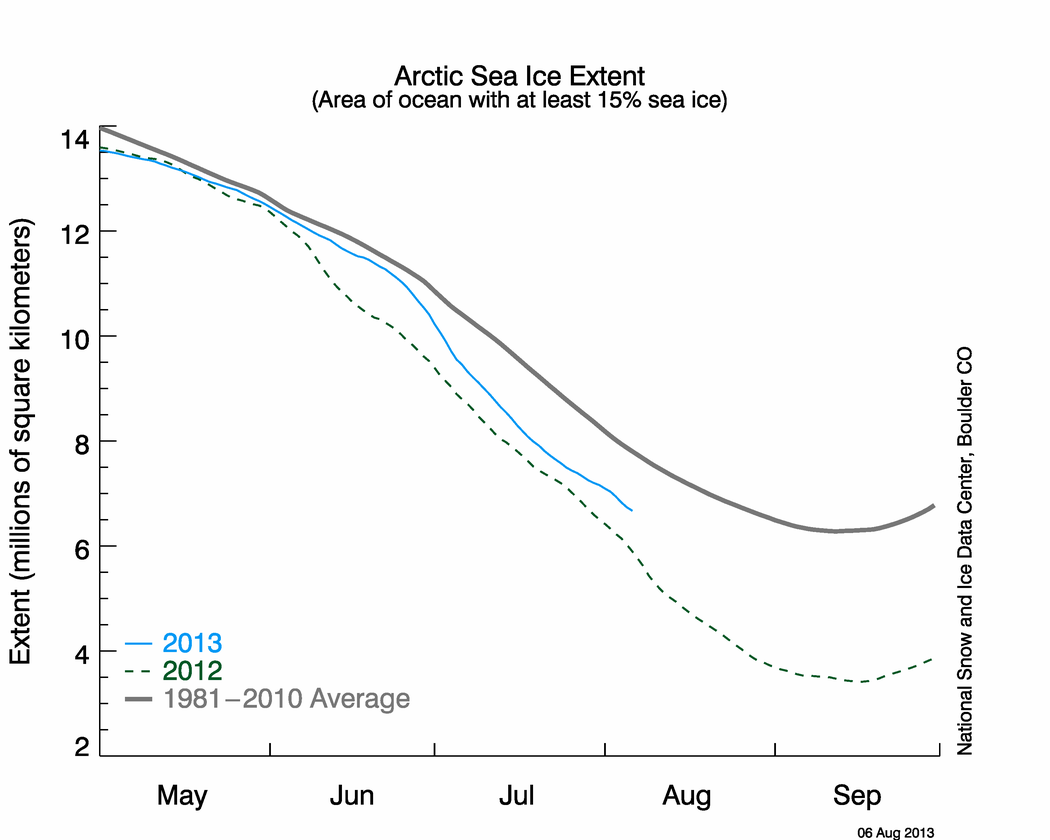
Pause in Arctic's melting trend - This summer's melt of Arctic sea ice has not been as profound as in the last two years, scientists said as the ice began its annual Autumn recovery. This leaves 2007's record low of 4.1 million sq km (1.6 million sq miles) intact.
But scientists note the long-term trend is still downwards

Yglesias - Beer and Climate Change - new research out of the Czech Republic indicates that climate change is bad for beer quality.Which seems like as good a time as any to discuss the perversity of agriculturally-oriented Americans tendency to oppose climate change legislation. Generally speaking, when you see some stuff being grown somewhere that’s because the climate in that place is well-suited to growing the stuff that’s being grown...

Ocean acidification: impact on key organisms of oceanic fauna - In addition to global warming, carbon dioxide emissions cause another, less well-known but equally serious and worrying phenomenon: ocean acidification. Researchers in the Laboratoire d'Océanographie (France), have just demonstrated that key marine organisms, such as deep-water corals and pteropods (shelled pelagic mollusks) will be profoundly affected by this phenomenon during the years to come.

August Seas Warmest in at Least 120 Years - NYTimes - The National Climatic Data Center has released its review of worldwide sea surface temperatures for August and for the stretch from June through August and finds that both the month and the “summer” (as looked at from the Northern Hemisphere) were the warmest at least since 1880, when such records were first systematically compiled. Sea ice in the Arctic appears to be starting the slow late-summer freeze after reaching its minimum extent several days ago, by a couple of estimates ( National Snow and Ice Data Center; International Arctic Research Center / Japan Aerospace Exploration Agency). Here’s the global sea ice trend, combining what’s going on up north and down south...


We're pumping out CO2 to the point of no return. It's time to alter course - A paper published in Proceedings of the National Academy of Sciences showed that the climate change we cause today will be "largely irreversible for 1,000 years after emissions stop". About 40% of the carbon dioxide produced by humans this century will remain in the atmosphere until at least the year 3000. Moreover, thanks to the peculiar ways in which the oceans absorb heat from the atmosphere, global average temperatures are likely to "remain approximately constant … until the end of the millennium despite zero further emissions". In other words, governments' hopes about the trajectory of temperature change are ill-founded...

Human-made Crises 'Outrunning Our Ability To Deal With Them,' Scientists Warn - The world faces a compounding series of crises driven by human activity, which existing governments and institutions are increasingly powerless to cope with, a group of eminent environmental scientists and economists has warned. Writing in the journal Science, the researchers say that nations alone are unable to resolve the sorts of planet-wide challenges now arising.

Saturday, September 12, 2009

week ending Sept 12

Labor Day Musings - (video & charts) For those of you who think we can "grow out of this", ponder this...delinquencies are translating directly into charged-off loans at a rate that threatens the entire banking system, and despite the claims of The Fed and Treasury that "things have been stabilized" there is no evidence of this in the loan performance data. No fractional reserve system can survive with charge-off rates much beyond 1% over any material amount of time. Rates beyond 2% threaten near-imminent collapse. This is inherent in how fractional reserves work...

Banks' funding needs: Total liabilities - The Economist - AN AMERICAN judge once said that it was hard to define pornography, but “I know it when I see it”. Something similar is true of doomed banks. It is difficult to establish any archetype for failure from the past two years. Yet there was a common ingredient in most failures: an over-reliance on wholesale borrowing.

The Real Story of “Zombie Banks” - The notion of the zombie is that it would be put in its grave by its creditors if it weren't for the black magic of government credit support guarantees and loans. These institutions have very distorted incentives, just as the zombies do in the horror movies. They're looking for things that even might have negative present value but have a possibility of producing good results. It's a long shot bet...

Five Largest Banks Had A Record $1 Billion At Risk During Average Trading Day In Second Quarter - Reuters noted yesterday that the Obama administration’s plan for overhauling the financial regulatory system is “bogged down in Congress,” and in particular has “no clear path forward in the Senate.” And in the meantime, as the Wall Street Journal reported today, “companies are selling exotic financial products similar to those that felled markets and the world economy last fall. And banks’ appetite for risk has grown”...

When the Going gets Tough, the Tough Run to the Government - In the end, like teenagers who hate Mother’s strictures when all is well, but run to Mommy whenever they get in trouble, the swashbuckling oligarchs of the financial sector ran to government for cover, owning up once again to the time-honored mantra of this country’s legendary rugged individualists: When the going gets tough, the tough run to the government. ...

One Year On: Banks After the Bailout - "Today we’re taking stock of how the nation’s banks are managing, one year after the government spent billions of taxpayers' dollars to bail them out." Transcript of radio interview with Eliot Spitzer and Tyler Cowen, professor of economics at George Mason University...

Geithner defends bank bailouts at town-hall meeting - (MarketWatch) - Treasury Secretary Timothy Geithner late Thursday responded to criticism of the Obama administration's bank bailout endeavors, addressing public frustration about billions in taxpayer dollars going to bankers.
"I wouldn't give a penny to a banker, to benefit a banker," Geithner said...

Good Billions After Bad - As the Bush administration waned, the Treasury shoveled more than a quarter of a trillion dollars in tarp funds into the financial system—without restrictions, accountability, or even common sense. The authors reveal how much of it ended up in the wrong hands, doing the opposite of what was needed.

Follow the money – BBC - Since the markets began to tumble in 2008, governments around the world have spent almost $11 trillion bailing out failing banks and trying to repair the financial system. Find out how the money was spent and what it means for the taxpayers who have funded it. There are two animated slide shows.

Ken Lewis Wants You To Know He Did NOT Come Up With This Shit - New expense policy governs excessive expenses - On Sept. 13, a new policy will be posted to the Bank of America Internet site to provide further clarity around expenses that may seem excessive or luxurious.
The new policy is a requirement of the Federal government's Troubled Asset Relief Program (TARP) and is mandatory for all participating institutions...

Canada Retains Its Ranking as Home to World's Soundest Banks - Bloomberg - Canada retained its position as home to the world’s soundest banks, the World Economic Forum said today, backing the country’s efforts to trumpet its industry as a model for the world’s largest economies. The United States was 108th out of 133 countries for that indicator, one below Tanzania.

WEF ranks US among most economically unstable nations - The United States fared badly in a new assessment of world economies, with the financial crisis accentuating its weakness as one of the most economically unstable nations, the World Economic Forum said Tuesday. In contrast with its overall ranking second only to Switzerland in the WEF's 2009 Global Competitiveness Report, the United States now placed 93rd among the 133 countries in terms of macroeconomic stability.

U.S. Alone Responsible 68.4% of Global Arms Sales - Despite a recession that knocked down global arms sales last year, the United States expanded its role as the world’s leading weapons supplier, increasing its share to more than two-thirds of all foreign armaments deals, according to a new Congressional study. The United States signed weapons agreements valued at $37.8 billion in 2008, Italy was a distant second, with $3.7 billion in worldwide weapons sales in 2008...

Military Industrial Complex = Bankrupt Nation - America is operating under a form of Economic Mass Psychosis. We have forgotten the concept of FREEDOM and how it interacts with SECURITY. We have been pursuing SECURITY on behalf of special interests and we have BANKRUPTED OURSELVES in so doing, thus sacrificing our FREEDOM as well as sacrificing our TRUE SECURITY. Ever wonder how our spending on our military grew to the INSANE point that the U.S. spends nearly as much as the rest of the world combined?

Pathology of the U.S. Debt Bubble — (incl bar graphs) There is another facet to this crisis which has remained shrouded in mystery: the steady and imbalanced growth in the indebtedness of financial institutions among G8 nations. Simply put, some of these banks or financial institutions have been allowed to borrow and lend a lot more money than reasonable, disrupting, in the end, the delicate balance in world’s credit markets.

Riding The Fed Train - It is difficult if not impossible to deny the firming of economic data in recent months. But that firming has been inexorably tied to a host of fiscal and monetary stimulus measures. Fiscal stimulus is dependent upon political will and Treasury's ability to sell debt cheap. On the monetary side, the Fed looks poised to sustain that stimulus until a potentially inflationary situation emerges. What - and how many - global distortions will emerge as a result of the Fed's extended zero-interest rate policy? And what will bring the new house of cards crashing down?

Fed Vice Chairman Kohn on Monetary Policy - This speech is a review of an academic paper (and a bit wonkish) ...here are some excerpts on two key topics: 1) how well the Fed followed the precepts of Walter Bagehot, and 2) if the Fed should target a higher inflation rate in a liquidity trap. From Federal Reserve Vice Chairman Donald Kohn: Comments on "Interpreting the Unconventional U.S. Monetary Policy of 2007-2009"

The Fed's Political Problem - Alan Blinder - As the financial crisis continues, the U.S. Congress is considering a bill that would jeopardize the independence of the Federal Reserve. This is a shame. Monetary policy should be protected from congressional politics....

Is The SEC Completely Useless? - But until something better comes along, don’t we still need the SEC’s fraud enforcement? Wouldn’t fraud run rampant without a “cop on the beat,” even one as ineffective as the SEC? Maybe not. A new study suggests that the securities market is a better regulator than the SEC...

Will Deep Pockets Always Win? It's In Roberts's Court - This year or next the supreme court could again remake the American system by permitting a flood of corporate money into our electoral campaigns, which are already drenched in dollars. Such a decision would create vast new opportunities for a particular class of Americans -- this time, corporate elites.

How Many Rabbits Are Left In The Hat? - from Rosenberg via Mish - While the Obama economics team is pulling rabbits out of the hat to revive autos and housing, there is nothing they can really do about employment; barring legislation that would prevent companies from continuing to adjust their staffing requirements to the new world order of credit contraction.

Weekend charts: the destruction of the "goods-producing" payroll The BLS establishment survey (nonfarm payroll) reports that the accumulated job loss since December 2007 is 5.02% (almost 7 million jobs... the industry contributions to total job loss show that the job destruction is heavily weighted in manufacturing and construction, which account for roughly half of the total drop in nonfarm payroll (-2.5% of the total -5%)...

The Incidence and Duration of Unemployment - Cleveland Fed - We can’t tell by looking at the rate whether people who are unemployed are staying unemployed longer or whether more workers have lost their jobs. This distinction could be important because each of these causes could result in a different set of problems for the labor force.

Recession Job Losses: 3 Views (chart)

Retail Hiring Shift May Show Growing Confidence in Recovery (Bloomberg) -- U.S. discount, grocery and restaurant chains are hiring a larger percentage of job applicants than seven months ago, signaling confidence the economy may be improving, software maker Kronos Inc. said.

Temporary Hiring Shows Job Rebound Isn’t Imminent: Chart of Day - (Bloomberg) -- U.S. companies are still reducing the ranks of temporary workers, showing that any rebound in overall employment won’t happen soon, according to William Hester, an analyst at Hussman Econometrics. Increases in the number of temporary jobs in 1991 and 2003 preceded similar recoveries in payrolls, as the chart illustrates.

Governments Shed More Workers – WSJ - State and local governments stood out as safe havens for workers during the recession's early stages. Now even they are laying off employees as officials rush to cut costs and balance budgets.

States Face Drop in Gambling Revenues - NYTimes - — Casinos and lotteries in most states are reporting a downturn in revenue for the first time, resulting in a drop in the money collected by state and local governments, according to new state data. The decline comes as states are rapidly expanding gambling in hopes of stemming severe budget shortfalls, and it indicates that gambling is not insulated from broader economic forces...

States Shut Down to Save Cash – WSJ - Across the country, cash-strapped state governments are shutting down business for a day at a time to save money. State offices are shuttered Friday in California, Maine, Maryland and Michigan. Some state agencies are closed in Georgia and Wisconsin, and most Colorado state offices will be shuttered on Tuesday. Other states, such as Arizona, have been trying to keep their operations open while furloughing thousands of workers.

Unemployment Is Much Worse Than You Think - There's another disturbing trend in the unemployment data: In the average recession, most job losses are attributed to temporary, cyclical factors--i.e., when the economy comes back, the jobs will, too. In this recession, however, more than half of jobs lost are gone for good. Data from the BLS shows that 53.9% of the unemployed were not on temporary layoff in August, up from 39.1% a year earlier and well above the 30-year average of about 34%

Voyaging Through U.S. Jobs - In honor of Labor Day, you may want to check out Job Voyager by Flare. It provides a graphical history of the rise and fall of different types of jobs in the United States from 1850 to 2000. Launch full size version. (enter job in box)

Comparing This Recession to Previous Ones: Job Losses - NYTimes - The chart shows job losses in this recession compared to recent ones.

Not Just Jobs - PWA - The older generation is slashing spending at a higher rate percentagewise than younger Americans in response to deteriorating economic conditions. That said, if one looks at the job losses that different demographic segments have experienced (as illustrated by the graph), one might have thought that the opposite was true...

Number of Hours Worked per Civilian Sees New Low - an updated chart which shows the average number of hours worked by a civilian (calculated by taking the employment to population ratio and multiplying that by the average # of hours worked per week). After a slight "rebound" last month, we are now at a new all-time (since 1964) low.

No Growth in Private Sector in 10 Years... Manufacturing in Almost 70 Years - Over the past decade, the U.S. private-sector has lost 203,000 jobs. That’s right: Zero job growth for 10 years. I reported this same stat back in May. But, in looking at the details behind this tremendous job stall, it is apparent where the majority of the jobs lost have come from... manufacturing.

Trade Activity Up, But Rebalancing Stalled - The good news in the data was the widely touted revival of global trade, an indication of economic healing. The bad news in the data was the return of an old enemy, a pattern of unbalanced trade. The July numbers raise the possibility that the external sector will weigh on US GDP growth in the third quarter. The trade deficit rose to $32 billion in July on the back of rising import growth that easily swamped export growth. Note to that higher oil prices were not the primary culprit; goods imports drove the trend...

Manpower: Hiring Plans Hit New Low - From MarketWatch: Employers’ hiring plans for the upcoming fourth quarter dropped to their lowest level in the history of Manpower’s Employment Outlook Survey, which started in 1962. A net -3% of employers said they’ll hire in the fourth quarter, down from -2% in the third quarter, on a seasonally adjusted basis…. Before this year, the survey’s previous low point was a net 1% hiring outlook for the third quarter of 1982…

This is Unacceptable - Job Market not to "Recover" until 2014! -
The average length of time looking for a job? 24.9 weeks, the longest since 1948.
Due to population growth the U.S. must create 125,000 jobs every single month just to keep up.
9 million: The number of workers forced to take part-time jobs who would rather work more hours. 33.1: Average hours in the workweek, near this summer's record low of 33 hours.

10 years/1 decade and we lost a quarter of a million jobs!
So I'd love for an economist to explain the fundemental workings of a "jobless recovery" because in my book that is just one more oxymoronic statement. What truly scares me about this chart is the source. Since it is from the BLS I can be confident that our net loss is way the heck south of 250k.

Long-term unemployment in Canada and the US - The more I look at the US, the more I see unpleasant parallels to Canada's experience of the 1990's - what Pierre Fortin called The Great Canadian Slump. Even after we emerged from the worst of the 1990-91 recession, we still had to deal with a large current account deficit, out-of-control government deficits and significant NAFTA-induced sectoral shifts. The outlook for the US is depressingly similar.

40% of Working Age Californians Jobless - The headline statistic, which comes out of a study by the non-partisan California Budget Project, in isolation sounds worse than it is...
From the San Francisco Chronicle: A report released Sunday says two of five working-age Californians do not have a job, underscoring the challenges in one of the toughest job markets in decades.

Depression Level Unemployment: 40 Percent Unemployment in the U.S.? - when we parse the data we realize that 25,000,000 Americans are unemployed or underemployed with half a million more coming our way this Friday. The employment situation on an aggregate basis simply does not reflect the devastation of this current recession. A recession that can destroy $11.2 trillion in American household wealth is not a common recession.

Unemployment Trust Funds Nearly Broke… - Point found an interesting link on the unemployment system that has an interactive map and a table of trust fund balance by state along with the amount each state has now borrowed to keep paying unemployment benefits. LINK HERE

New Highs in Unemployment Insurance Claims - SF Fed - The number of ongoing claims for unemployment insurance (UI) benefits recently reached a historic high in the United States. In this Economic Letter, we update past work on trends in UI receipt. Our analyses identify an upward trend in UI receipt over the past two decades as the composition of the unemployment pool has shifted toward permanent job losers, which has partially reversed the earlier decline. However, this effect may have been offset by the lengthening of unemployment spells that occurred during the same period. This is likely to cause UI benefits to lapse for some recipients as the current downturn continues.

Broad Unemployment Across the U.S. - NYtimes - Interactive Map

The Real News About Jobs and Wages -- Why aren't we hearing more about the worst job and wage situation since the Great Depression? The latest employment figures show job losses continuing to grow. So why isn't the media screaming? Partly because these job and wage losses are not, for the most part, falling on the segment of our population most visible to the media. They're falling overwhelmingly on the middle class and the poor.

U.S. Poverty Rate Rises to 11-Year High as Recession Takes Toll - (Bloomberg) -- The U.S. poverty rate rose to the highest level in 11 years in 2008 and household incomes declined as the first full year of the recession took its toll, government data showed. The poverty rate climbed to 13.2 percent from 12.5 percent, and the number of people classified as poor jumped by 2.6 million to 39.8 million...

Survey: “The Anguish of Unemployment” - NPR Money highlights a new survey by Rutgers. The survey shows that the great recession of 2007-2009 may have long-lasting financial and psychological effects on millions of people, and therefore on the nation’s social fabric. Two thirds of respondents say they are depressed, over half have borrowed money from friends or relatives, and a quarter have skipped mortgage or rent payments...

Lobbyists Feel the Pinch As Downturn Hits K Street - In a year when Washington's influence industry should be thriving, with epic battles over health-care and energy legislation, lobbying in many sectors is in marked decline as defense contractors, real estate firms and other companies pull back in a down economy.

Migrants hit by global downturn - There has been a dramatic decline in the number of people going to work abroad since the start of the global downturn, according to a new report.
The research, commissioned by the BBC World Service, also showed that those already abroad are more likely to stay where they are than return home.

Broader (BLS) Unemployment (Chart)

Depiction of a System in Decline - productivity/wages - "The implications of this chart are staggering...."

if you havent read enough about unemployment by this time, here's more takes on the report: Paul Krugman, Spencer, Calculated Risk, Calculated Risk II, Brad DeLong, Real Time Economics, Andrew Leonard, Credit Writedowns, The Curious Capitalist, The Big Picture, Robert Reich.

How Bad Will Unemployment Get, And What Can We Do About It? - On the national level, high unemployment is both cause and effect concerning other problems with the economy. As we’ll see below, high unemployment results from a weak economy and - in turn - weakens the economy. Until the causes of, and solutions to, high levels of unemployment are understood, we will not be able to solve the problem.

Jobs report points to better profits, at workers' expense - In the context of many other economic reports since June pointing to the beginning of a recovery, the underlying employment data suggest that the early benefits of any recovery will flow directly to many companies’ bottom lines. That's good for stock prices.

Top 1 Percent of Americans Reaped Two-Thirds of Income Gains - Two-thirds of the nation’s total income gains from 2002 to 2007 flowed to the top 1 percent of U.S. households, and that top 1 percent held a larger share of income in 2007 than at any time since 1928, according to an analysis of newly released IRS data by economists

The Myth of a Jobless Recovery - As with all oxymorons, no intelligent person would/should be foolish enough to add these buzz-words to his/her lexicon. By definition, an “economic recovery” means a net increase in economic activity, which also dictates positive wealth-generation. When an economy is producing wealth, this must also result in job-creation.

The Gospel of Economic Prosperity: Lessons from the Great Depression Part XVIII. Pretend and Spend and Success will Come. - The gospel of infinite prosperity is back in full bloom. Echoing from the television talking heads and radio pundits preach that the economy is on the mend because we have spent our way into prosperity. This recovery, as we are led to believe, is occurring even though jobs are being lost at the rate of 2.4 million a year and this is somehow good...

Nobel economist sees a roaring recovery - At the ripe age of 78, Nobel economist Gary Becker finds himself the pin-up hero for libertarians around the world convinced that massive government response to the Great Contraction of 2008-2009 is not only unnecessary but almost certainly a threat to economic freedom as well.

Economy Will Be Back In Recession By Early Next Year - The bearish case, meanwhile, is that this recession is different--a deleveraging recession--and that full recovery will take years. The key element of this latter view is ongoing weakness in consumer spending. To wit:
Consumers still account for 70% of the spending in the economy.
Consumer spending growth will be constrained.

Dissecting The Keynesian Myth Of Pent-Up Demand - please tell me where the pent-up demand is? Show me how the roasted demand-pigeons will fly into the mouths of the priced-for-perfection equities. The rally in equities seems to imply that Western consumers have set aside thousands of dollars and Euros in every one of the bubble years. But if that is the case, why are they continuing to default on their debt obligations? Indeed, why are they spending less and less and paying off more and more of their debt?

Roubini: U-shaped recovery is possible - "I believe that the basic scenario is going to be one of a U-shaped economic recovery where growth is going to remain below trend ... especially for the advanced economies, for at least 2 or 3 years," he said at a news conference here.

Double-dip recession risk rising: El-Erian (Reuters) - The U.S. economy faces an increasing risk of stalled growth in 2010, the chief executive of top bond fund Pimco said on Friday, adding that rallies in the equity and bond markets have outpaced economic trends.

The Coming Consequences of Banking Fraud - The Double Dip Recession, or the “W” shaped recovery, should not be discussed in the realm of economics but rather in the more apropos realm of financial fraud. The fact that the upleg of the “W” shaped recovery that is occurring now will inevitably crumble in spectacular fashion will not be a result of any free market principle, but rather the direct consequence of a fraudulent scheme executed by an elite global financial oligarchy, otherwise known as Central Banks.

Bank Of China Representative: "The Real Economic Crisis Is Just Starting" - Interview with Zhu Min, Bank of China Vice President: "It's not only overconfidence, it's overmyopic: Wall Street feels the crisis never happened. It seems to me the financial crisis is not over yet, but it has stabilized from a cliff drop. That's one thing. The real economic crisis is just starting."

Depression versus Recession? - Ritholtz - Despite most of the economics profession declaring the recession over — I think they are premature — I got into an interesting debate with Mish last night over the state of the economy. I have been calling this the “Great Recession,” and suggested the worst of it is over, and we are now in a not-so-great, ordinary recession. Mish believes we are in something far worse: A Depression (See Depression Debate – Is this a Depression?)

August 2009 FIRE Economy Depression update – Part I: Snowball in Summer Credit crunch induced commodity, goods and services supply crash meets government money wave. Can the Fed and Congress stop what they started? The major difference between the 1980 to 1983 recessions and the one that started in Q4 2007: the Fed created the 1980 to 1983 recessions on purpose. This one is running on its own, out of control, with no apparent obstructions to brake the fall.

Economist: U.S. won't tolerate a 'Lost Decade' - The long-simmering problems that boiled over into a global financial crisis last September require a strong government hand in the workings of the U.S. economy and financial system, according to economist and author James K. Galbraith. In a wide-ranging interview, he shared his views on how the crisis has changed our economic system.

Financial Crisis and Reform Déjà Vu -The financial crisis has set a lot of records so far; it's certainly the worst US banking crisis of my lifetime. Some see such crises as unique events; each one is singular and there's not much to be learned about how to handle one from looking at past crises. For example, there's no precedent that I know of for a banking crisis involves the failure of the biggest counterparties for credit default swaps.

Alan Greenspan: 'This will happen again' - The world will suffer another financial crisis, former Federal Reserve chief Alan Greenspan has told the BBC. "That is the unquenchable capability of human beings when confronted with long periods of prosperity to presume that it will continue." Mr Greenspan described the behaviour as "human nature".

What We’ve Learned: Our (Increasingly) Non-Market Economy - Economists haven’t gotten many things right lately, and we don’t even agree on what we’ve gotten wrong. We still talk about the market as though it is the economy, and about the economy as if it is a market. This talk misleads us, for three big reasons...

Understanding Why Most “Economists” Simply Get it WRONG…
Are you a highly educated “economist”? If you’ve been “highly trained” then the odds are that your mind has been simply programmed full of misconceptions, half truths, bad math, lies, and marketing manipulations. Perusing the latest reports at the St. Louis Fed I came up with this just released and very fine tax payer funded work...

Priceless: How The Federal Reserve Bought The Economics Profession - The Federal Reserve, through its extensive network of consultants, visiting scholars, alumni and staff economists, so thoroughly dominates the field of economics that real criticism of the central bank has become a career liability for members of the profession, an investigation by the Huffington Post has found. This dominance helps explain how, even after the Fed failed to foresee the greatest economic collapse since the Great Depression, the central bank has largely escaped criticism from academic economists.

Serious credit crunch remains; and it will until the labor market turns - the Kansas City Fed measures the Kansas City Financial Stress Index (KCFSI), which is an composite index of 11 financial variables that reflects stress in the financial system. What does it imply about credit flow right now? It's anemic; except for revolving home equity lines of credit, credit extended across all loan types is just a few %-points higher than in January 2008 (nearing two years ago), and falling.

Fed must not leave rates too low: Hoenig - Hoenig, who is regarded as one of the Fed's most hawkish, or anti-inflation officials, will be a voting member of its policy-setting committee next year: "In this environment, one of the Federal Reserve's major challenges will be how to pull back its highly accommodative monetary policy without undermining the recovery and without igniting inflationary expectations"

Easy money fuels all markets, but not forever - Reuters - "Asset classes are up due to massive credit, fiscal, and monetary stimulation that is bleeding into them," "Essentially, this bullish action in several markets may be a sign that the 109 percent year-over-year increase in the monetary base may finally start translating into money supply growth,"

Recovery and the fear of inflation - The economy is still limping, job losses are still rising, and consumers are still reluctant to open their wallets. So it’s the perfect time to worry about . . . inflation? Apparently so, because, of late, the cries of inflation hawks have grown increasingly loud. Unless the Fed starts slowing things down, they say, we’ll face price jumps that qualify as “hyperinflationary”.

The Latest Inflation Hawk Conspiracy Theory - The inflation hawks have come up with a convoluted explanation for why the market doesn’t seem to be indicating looming hyper-inflation—they’re saying investors think the government will fudge the CPI to under-report inflation...

A tale of two inflations - For some time now, the disparity between price increases for imported goods and price increases for domestic goods and services has been of great interest to me and, after working through all of the applicable Labor Department data on this subject, it quickly becomes clear that there is an interesting story to tell here about two very different types of U.S. inflation in recent years - domestic inflation and imported inflation.

Notes on This Week’s Column: Inflation Fears - - My column this week is about the curious fact that we’ve seen a resurgence of inflation fears even though the economy is still struggling and even though there’s no sign of price pressure either in current inflation data or in more forward-looking numbers (like the yield on the ten-year bond). A sampling of the inflation hawks’ cries can be found here, here, here, and here. A study by the New York Fed, by contrast, offers up one reason why the Fed’s pumping of money into the economy has not been inflationary: banks are holding massive excess reserves.

The inflation permahawks - It’s hard to find someone who’s worried about inflation right now who isn’t always worried about inflation. If you stay worried about inflation for decades, of course, eventually you’ll be able to claim justification.

SF Fed Economist Suggests 2% Inflation Target May Be Too Low -- In a paper to be presented Thursday afternoon at Brookings Institution, John Williams, a top staff economist at the SF Fed, extracts some lessons from the way the global crisis has forced central bankers to bring interest rates down near zero — effectively exhausting their main tool to support the economy. He asks whether they might in normal times want to allow a bit more inflation, and hence higher interest rates, to give themselves more room to lower rates if they get into this predicament again.

Overcoming America's Debt Overhang: The Case for Inflation - The graph shows total debt outstanding in the United States, both secured and unsecured, as a percentage of GDP. Greg Mankiw, former Chair of the Council of Economic Advisors, argues that the Fed must make a credible commitment to inflation over the medium term in order to produce negative real interest rates, avoid a deflationary trap, and boost demand. In arguing in the Financial Times for a "pre-announced, temporary, globally co-ordinated bout of moderate inflation," the London School of Economics' Tim Leunig notes that 4 percent annual inflation would "help government finances by inflating away 10 per cent of total government debt...

A comment on the Deficit and National Debt - President Bush argued in February 2001 that his fiscal policy "returns ... the surplus to the American taxpayers". In his 2001 testimony to Congress, then Fed Chairman Alan Greenspan supported President Bush by offering projections of "an on-budget surplus of almost $500 billion ... in fiscal year 2010". Greenspan offered a projection of "an implicit on-budget surplus under baseline assumptions well past 2030 despite the budgetary pressures from the aging of the baby-boom generation, especially on the major health programs."

America and Its Deficits: Are We Broke Yet? - At some point this starts to matter, right?
Well, yes, at some point it does have to start mattering. But one of the great mysteries of modern politics and economics is where exactly that point might be.

How Much Debt Is Too Much? - The latest budget projections show the national debt rising from $5.8 trillion last year to $7.6 trillion this year and $14.3 trillion in 2019. According to the Congressional Budget Office (CBO), the debt will rise from 40.8% of the gross domestic product in 2008 to 53.8% in 2009 and 67.8% in 2019. At what point are the economic consequences in terms of inflation, higher interest rates, slow growth or a collapsing dollar so severe that radical action is required?

Why Default On US Treasuries Is Likely - Many predict that the government will inflate its way out of this future bind, using Federal Reserve monetary expansion to fill the shortfall between outlays and receipts. But I believe that it is far more likely that the United States will be driven to an outright default on Treasury securities, openly reneging on the interest due on its formal debt and probably repudiating part of the principal.

Treasurys Debate: Who Would Buy a Sell-Off? - Inflating or repudiating has dire consequences for the many countries who hold and continue to buy large amounts of U.S. debt. Quite a few countries own too much to just sell because who would buy? Additionally the extent to which the greenback is the currency used in many transactions globally and the number of countries that peg to the greenback creates an urgency to seek out a globally coordinated solution.

Federal Reserve Balance Sheet Update: Week Of September 9 - Securities held outright: $1,501 billion (an increase of $128.7 billion MoM, resulting from $32.6 billion in new Treasury purchases, $82.4 billion increase in MBS and $13.7 billion in Agency Debt), or $10.7 billion increase sequentially.

ROUBINI: The Dollar Might Crash* - "If markets were to believe, and I’m not saying it’s likely, that inflation is going to be the route that the U.S. is going to take to resolve this problem, then you could have a crash of the value of the dollar,” Roubini said. “The value of the dollar over time has to fall on a trade-weighted basis, but not necessarily relative to euro and yen.”

The Wait for Financial Reform - NYtimes - We are barely emerging from the greatest financial crisis since the 1930s. From last September to March, it was downright frightening. Yet by the time Congress left town for its summer recess, financial reform appeared to be losing steam.

Wall Street Bundles Life Insurance - NYtimes - The bankers plan to buy “life settlements,” life insurance policies that ill and elderly people sell for cash. Then they plan to “securitize” these policies, in Wall Street jargon, by packaging hundreds or thousands together into bonds.
The earlier the policyholder dies, the bigger the return — though if people live longer than expected, investors could get poor returns or even lose money.

Credit Rating Agencies Took “Bribes” for Higher Ratings - You may have heard how the big ratings agencies - Moody's, S&P and Fitch - "sold their soul" by rating toxic assets and mismanaged companies much more highly than they should have been rated. But as the following discussion shows, the ratings agencies effectively took bribes for higher ratings, just like people who knowingly authenticate forged art so that they will earn a higher fee

Accountants Misled Us Into Crisis - That is one of the clear lessons of the financial crisis that drove the world into a deep recession. We now know the major banks were hiding dubious assets off their balance sheets and stretching rules if not breaking them. We know that their capital was woefully inadequate for the risks they were taking.

Tactical Error: Health Care vs Finance Regulatory Reform - I believe the brain trust behind the Obama White House has made a huge tactical error. There was a narrow window to effect a full regulatory reform of Wall Street, the Banking Industry and other causes of the collapse. Instead, the White House tacked in a different direction, pursuing health care reform.This was an enormous miscalculation.

Wall Street's Mania for Short-Term Results Hurts Economy - Its particularly disappointing that so little attention was paid this week to a report by a panel convened by the Aspen Institute on the "short-termism" that has now become hard-wired into the culture of Wall Street and corporate America. Their complaint is that the focus on short-term financial performance by investors, money managers and corporate executives has systematically robbed the economy of the patient capital it needs to produce sustained and vigorous economic growth...

Restricting bankers’ bonuses won’t help address root causes of the crisis - Telegraph - The desire for retribution against banks and their highly paid workers is understandable, but should run no deeper than the desire for retribution against all those who failed in their duties, allowing the financial system to seize up – including regulators, central bankers and politicians.

U.S. Government The New Sub-Prime Lender - With the U.S. housing market now experiencing its worst collapse in history as the aftermath of that bubble, and with no “bottom” in sight, the U.S. government is once again trying to take the easy way out – this time by trying to re-inflate the same bubble which has just burst.

Mortgage Markets: The Public Option - Only one lender of consequence remains: the federal government...nearly 90 percent of all new home loans are funded or guaranteed by taxpayers...If the government got out of the mortgage business, old-fashioned bank lending would revive. But the interest rates would be higher than the artificially low rates being offered by government agencies...

Faltering Construction Loans = More Bad News for Banks -
Reports filed by banks with the Federal Deposit Insurance Corporation indicate that at the end of June about one-sixth of all construction loans were in trouble. With more than half a trillion dollars in such loans outstanding, that represents a source of major losses for banks.”

Troubles For ‘Prime’ Borrowers Intensify – WSJ - The mortgage-delinquency rate among so-called subprime borrowers reached 25% in the first quarter but appears to be leveling off, rising only slightly in the second quarter. The pace of delinquencies for prime borrowers is accelerating. Since prime loans account for 80% of U.S. bank exposure to mortgages and credit cards, these losses could ultimately exceed those from weaker borrowers.

Housing Bottom - Oh Really? - The U.S. propaganda machine was positively giddy last month when the latest “existing home sales” data showed a “jump” to an annualized rate of 5.2 million units. This mindless euphoria was epitomized in a Bloomberg article, “We can count on housing no longer being a drag on the U.S. economy.”
Oh really? Just a few days earlier, it was announced that foreclosures had set another all-time record in July...

Median Incomes and Economic Obsolescence of Large Homes - One thing that has led me to believe that the housing market is largely at bottom is the fact that many houses are selling at less than replacement cost. The report on median incomes released yesterday, though, suggests to me a flaw with my line of reasoning. While the average new house has grown about 20 percent in size over the past ten years, median household incomes have actually fallen a bit. If house size is a proxy for house quality, then house quality has outstripped the ability of people to pay for it.

Wealthy Families Succumb to Bankruptcy as Real Estate Crashes - (Bloomberg) -- Wealthy individuals’ Chapter 11 bankruptcy filings jumped 73 percent in the second quarter from a year earlier, according to the National Bankruptcy Research Center, a research firm in Burlingame, California. More individuals or families with at least $1,010,650 in secured debt and $336,900 unsecured are using Chapter 11 of the U.S. bankruptcy code typically associated with business reorganizations.

Interest Only Loans: Another Time Bomb - From the NY Times: The House Trap - An analysis for The New York Times by the real estate information company First American CoreLogic shows there are 2.8 million active interest-only home loans worth a combined total of $908 billion. The interest-only periods, which put off the principal payments for five, seven or 10 years, are now beginning to expire.

U.S. foreclosures near record, peak in late '10: report - (Reuters) - U.S. mortgage foreclosure filings in August hovered near July's record high despite broad efforts to keep borrowers in their homes and will probably rise for another year, according to a report released on Thursday...The pipeline of early stage foreclosures and delinquent loans is still probably going to overwhelm the system's ability to quickly modify terms...

Option ARM Disaster Arrival: Mortgages More Problematic than Originally Thought. $134 Billion Recasting in Next Two Years. 94 Percent Made only Minimum Payment. Only 35,000 of the 1 million Option ARM loans Modified. Option ARMs are back in the limelight showing that they have not gone away. These toxic mortgages allowed borrowers a buffet of payment options. However, in recent data released this week we are told that things are much worse than we had initially thought...

Fitch on Option ARM Recasts - Of the $189 billion securitized Option ARM loans outstanding, 88% have yet to experience a recast event ... Of these loans that have not yet recast, 94% have utilized the minimum monthly payment to allow their loans to negatively amortize.

Real Estate - The 800,000 Pound Deflationary Gorilla - The housing market is rapidly deteriorating under the surface. A housing price collapse is a highly deflationary event because it affects so many banks and individuals. We are not close to a bottom in the real estate market and it is essentially almost impossible for it to come before the 2011-2012 time frame...Banks are now hiding foreclosures and refusing to list foreclosed homes on the market! Even worse, banks are allowing people who stop paying their mortgage to stay in their homes for 2 YEARS OR MORE without taking back the house.


Treasury: Millions More Foreclosures Coming - before the House Financial Services Committee, Subcommittee on Housing and Community Opportunity: "We recognize that any modification program seeking to avoid preventable foreclosures has limits, HAMP included. Therefore, even if HAMP is a total success, we should still expect millions of foreclosures... "

FHA Lenders with High Default Rates - HUD has a great tool to track FHA lender performance: Neighborhood Watch Early Warning System - the overall FHA default rate is 4.63%...the winner is Mortgage Depot Inc. with a 48.65% default rate...

Cramdown Is Back: Banks Against Homeowners, Round 2 - House Financial Services Committee Chairman Barney Frank (D-Mass.) tells the Huffington Post he plans to revive the effort to give bankruptcy judges the authority to renegotiate home mortgages -- by making it part of this fall's much-anticipated financial regulatory reform bill.

The Great American Affordability Scheme - There was a time when mortgage loans were provided for maximum 50% or 60% of the purchasing price, and when they were standard paid off in 5 or 10 years. At today's prices, compared to people's incomes, that is unthinkable.

US consumption datapoint of the day - By the early ’90s, American families had, on average, twice as many possessions as they did 25 years earlier. By 2005, according to the Boston College sociologist Juliet B. Schor, the average consumer purchased one new piece of clothing every five and a half days.


University of Michigan Consumer Sentiment -(graph)- From MarketWatch: Consumer sentiment improves in early Sept, UMich - "Consumer sentiment improved sharply in early September, according to media reports on Friday of the Reuters/University of Michigan index. The consumer sentiment index rose to 70.2 from 65.7 in August." Although this is being reported as a "sharp increase" and above expectations, sentiment is still low - and this is just a rebound to the June levels.

Who is increasing their spending - debtors or creditors? - I don't know the answer, but I do know it's the right question to ask. Low interest rates encourage spending and recovery, but this can mean that debt either rises or falls, depending on who does the extra spending...if the people doing the extra spending are debtors, rather than creditors....then there is a danger that the recovery will stall...

Tracking the Consumption Decline - Econbrowser - Figure 1 shows how the year-on-year growth in consumption has hit very low rates, lower than at any period in the past forty years. In Figure 2, I show individual component year-on-year growth rates. (Durables, nondurables and services are 10%, 21.8%, and 68.1% of nominal consumption, respectively.) In Figure 3 I show the log level of real consumption (blue line), converting consumption measured in Ch.2005$ into Ch.2000$

LIVING IN BEVERLY HILLS - There appears to be many more BMW and Mercedes vehicles on the road than people with enough income to own one of these vehicles. How can this be? I was befuddled. After a little research it became quite clear. The graphs below tell the whole sordid story. Borrow today, live like a Beverly Hills hotshot, roll the loan or lease into the next loan or lease in 3 years, and don’t be troubled about the future.

Credit Debt Has Dug a Two-Decade Hole - Consumer credit debt has risen to $2.5 trillion from $400 billion in 1980. Consumers have an average of 5.4 credit cards with $973 billion outstanding. Excluding mortgages, the average American with a credit file is responsible for $16,635 in debt, according to Experian. It’s taken Americans three decades of overspending and under-saving to get into this pickle.

Census Bureau: Real Median Household Income Fell 3.6% - From the Census Bureau: The U.S. Census Bureau announced today that real median household income in the United States fell 3.6 percent between 2007 and 2008, from $52,163 to $50,303... There were 39.8 million people in poverty in 2008, up from 37.3 million in 2007. Meanwhile, the number of people without health insurance coverage rose from 45.7 million in 2007 to 46.3 million in 2008

A Decade With No Income Gains - The typical American household made less money last year than the typical household made a full decade ago...that’s the big news from the Census Bureau’s annual report on income, poverty and health insurance; these numbers are adjusted for inflation.
In the four decades that the Census Bureau has been tracking household income, there has never before been a full decade in which median income failed to rise.

A Lost Decade for US Households? Try a lost Generation (or two)! - a set of indicators that clearly delineates a prolonged and precipitous decline of America gets so little coverage, zero outrage, and generates complete inaction. The Census Bureau reported that median household incomes slid over the last decade. Of course, this new figure also means that household incomes only increased ~$5k (inflation adjusted dollars) or ~11% over 35 years! All of this so called gain has to do with improvements in the household's second income.

Consumer Credit Deflating… While the whole world of “economic experts” are talking about and bracing for inflation, consumer credit (credit being the largest part of the money supply) is CONTRACTING at a RECORD PACE. That’s what exponential curves do when they have peaked. The math does not allow anything to grow unabated year after year into infinity, that only occurs in the minds of idiot politicians and poorly trained economists who received their education in the land of fiat – America.

U.S. Consumer Credit Falls by a Record $21.6 Billion (Bloomberg) -- U.S. consumer credit plunged more than five times as much as forecast in July as banks restricted lending terms and job losses made Americans reluctant to borrow. Consumer credit fell by a record $21.6 billion, or 10 percent at an annual rate, to $2.5 trillion, according to a Federal Reserve report...

Americans slash their borrowing by a record rate. Is this a good thing? - The Wall Street Journal paints a gloomy picture: "The credit conditions bode ill for a quick rebound in consumer spending, which accounts for 70% of gross domestic product" I understand the economic
argument the Journal is trying to make but how much of it is based on the illusion (or perhaps the crutch) of credit-based wealth?

Will the Demand for Assets Fall When the Baby Boomers Retire? - CBO - Today CBO released a background paper examining whether the demand for assets, such as stocks and bonds, will fall after the retirement of the baby-boomer generation—the segment of the nation’s population whose oldest members turned 62 in 2008. As a population ages, the share of older, retired people selling assets increases relative to the share of younger, working people buying them.

Over Ten Years, Bush Tax Cuts Cost 2.5 Times As Much As House Democrats’ Health Care Plan - One of the main criticisms opponents of health reform have been wielding is that it is simply too expensive...However, as a new report from Citizens for Tax Justice (CTJ) pointed out, “many of the lawmakers who argue that the health care reform legislation is ‘too costly are the same lawmakers who supported the Bush tax cuts,” which cost almost $2.5 trillion over the decade after they were first enacted (2001-2010).

Malpractice - When it comes to health care, economists ignore their own rules. Fundamental economic principles tell us that goods should be sold at their marginal cost of production—the cost of producing one more unit of the good. The price–equals–marginal–cost principle maximizes economic efficiency and limits opportunities for fraud and corruption. Unfortunately, when it comes to health care, these principles are routinely violated.

Krugman: Why the public option matters - First, even a public plan with limited bargaining power will help hold down overall costs...Second, a public plan would probably provide the only real competition in many markets....Third is the politics. Remember, to make reform work we have to have an individual mandate. And everything I see says that there will be a major backlash against the idea of forcing people to buy insurance from the existing companies.

The Public Plan Is Not the Same Thing as Cost Control - one of the themes I'm seeing in a lot of the commentary is that the absence of a public plan is essentially equivalent to the absence of cost control, and the presence of a public plan is pretty much the presence of cost control. For the public plans on the table, that's not true, at least not in any way I can see.

Health Care in Japan: Low-Cost, for Now - Aging Population Could Strain System -- Half a world away from the U.S. health-care debate, Japan has a system that costs half as much and often achieves better medical outcomes than its American counterpart. It does so by banning insurance company profits, limiting doctor fees and accepting shortcomings in care that many well-insured Americans would find intolerable.

Improved Health Insurance Reform Flowchart - an updated flowchart that illustrates how many of the currently uninsured will end up with Medicaid, subsidized individual insurance, or unsubsidized individual insurance; how many people will end up using the Public Option; and what exactly those "new consumer protections" will accomplish.

California's Real Death Panels: Insurers Deny 21% of Claims - Reuters - PacifiCare's Denials 40%, Cigna's 33% in First Half of 2009 - More than one of every five requests for medical claims for insured patients, even when recommended by a patient's physician, are rejected by California's largest private insurers, amounting to very real death panels in practice daily in the nation's biggest state.

Pyrrhic victory on health reform? - By the bizarre, dysfunctional rules of Washington policymaking, Republicans seem poised to score a big win. Either they'll kill health reform or they'll force Democrats to pass such a watered-down mishmash that they will have endless fodder for election-year attacks in 2010 and beyond. That would be a Pyrrhic victory... it will just be a matter of time before the inevitable happens and insurance becomes unaffordable for most middle-class households and businesses...

Health care, without the politics - Noisy health-care debate overlooks free clinics' struggles - Over the past year, free clinics across the country have seen a 20 percent decrease in donations and a 40 percent to 50 percent increase in patients. Last year, the clinics — which largely have been excluded from the health care debate — treated 4 million people. This year, they'll serve some 8 million...

And here is the text for the Obama Health Care speech.

An Address To Our Schoolchildren - Neither Republicans or Democrats want you to see this graph. This is how much each American, from 1970 to today, is in debt because of our government's policies...Let me be clear: In the last two years your mother, father, school teacher, grandma and grandpa have stuck each and every American with $10,000 in personal debt, and since 2000 the amount of debt you have had forced upon you has doubled.

Social Security Trust Fund Shocker: $6 Billion August Deficit - The Social Security Trust Fund reported an August net deficit of $5.865 Billion. This is the largest monthly deficit in nineteen years. The Actuarial analysis of the Fund is misdirected. Their focus is based on the future value. It should be focused on the here and now.

Schools Aided by Stimulus Money Still Facing Cuts - NYTimes - How much the federal money has succeeded in stabilizing schools depends on the state. In those where budget deficits have been manageable, stimulus money largely replaced plunging taxpayer revenues for schools. But in Arizona, California, Georgia and a dozen other states with overwhelming deficits, the federal money has failed to prevent the most extensive school layoffs in several decades, experts said.

Surge in Homeless Children Strains School Districts - NY Times - A national surge of homeless schoolchildren is driven by relentless unemployment and foreclosures. The rise, to more than one million students without stable housing by last spring, has tested budget-battered school districts as they try to carry out their responsibilities — and the federal mandate — to salvage education for children whose lives are filled with insecurity and turmoil.

Blame the universities? - Economist - DAVID LEONHARDT starts out his piece (NYTimes) today with a provocative opening: "If you were going to come up with a list of organizations whose failures had done the most damage to the American economy in recent years...I would suggest that the list should include a less obvious nominee: public universities...the American system of higher education may be the best in the world. Yet in terms of its core mission — turning teenagers into educated college graduates — much of the system is simply failing.

Harvard, Heal Thyself - Harvard Medical School is exactly the kind of private institution on which the public welfare depends. No doubt the easiest, albeit not the only, way to undermine Harvard's mission would be to invite the pharmaceutical industry to offer secret bribes to its faculty in order to ensure that their research and teaching reflected not their scholarly judgment but the profit motives of these mega-corporations. This may, however, be just what is happening...

Harvard and Yale endowments suffer heavy losses - (Reuters) - Harvard and Yale, America's two richest universities, said on Thursday their endowments lost roughly 30 percent of their value last year, showing how severely the financial crisis battered even the world's best managers. Both schools warned about the declines late last year when their presidents told students, faculty and alumni about upcoming heavy cutbacks...

College for $99 a Month - The next generation of online education could be great for students—and catastrophic for universities

German bloggers’ Internet Manifesto on journalism’s future makes waves - After stirring up their own country, the German blogger elite has launched an international version of their Internet Manifesto in English. Fifteen authors of Germany’s most popular blogs have signed a declaration about how journalism works today...

There Is Another Shoe To Drop In The Global Economic and Financial Crisis – And The Focus Will Be On Europe’s Perifery - it is noteworthy just how many in the “weaker” countries have often sought refuge in the global nature of the crisis, rather than asking themselves just what it is exactly about their own particular economy that makes them “weaker”, and more vulnerable, and why the crisis has struck more severely “here” rather than “there”...

Interest rates ‘could rise sharply early next year’ - UK Telegraph - Interest rates could start to rise early next year – and by more than in previous cycles, according to an economist at a City fund manager. This would cause a large rise in mortgage repayments for borrowers on tracker and other variable-rate mortgages, some of whom are staying afloat financially only because interest rates are currently at an all-time low

Mortgages: bank profit margins hit record high – UK Telegraph - Bank profit margins on mortgages have hit a new record with the latest figures which disclose the discrepancy between their costs and rates charged to customers.

In August, QE hit the economy - What are UK banks up to? Last month, their cash deposits at the Bank of England fell by 6 percent. In crude cash terms, banks withdrew almost ₤10 billion. In the previous six months, banks had accumulated huge deposits. This was due to quantitative easing. The BoE was buying up bank holdings of Treasury paper. In return, it paid for this paper by increasing bank deposits held at the Bank of England. This was how the BoE were "printing cash"; it was generating big increases in reserve balances. In principle, UK banks could have withdrawn that cash and used it to create new credit. However, during the first half of this year, banks preferred to park the money in the vaults of the Bank of England. That all changed in August, when for the first time since QE began, deposits shrank.

UK 'could face blackouts by 2016' - The government's new energy adviser says the UK could face blackouts by 2016 because green energy is not coming on stream fast enough.
David MacKay, who takes up his post at the Department of Energy on 1 October, says that the public keep objecting to energy projects.

World's Stocks Controlled by Select Few - Companies from US, UK and Australia have the most concentrated financial power.- A recent analysis of the 2007 financial markets of 48 countries has revealed that the world's finances are in the hands of just a few mutual funds, banks, and corporations. This is the first clear picture of the global concentration of financial power, and point out the worldwide financial system's vulnerability as it stood on the brink of the current economic crisis.

Poverty, growth, and sustainability - The extent and depth of poverty in the world today is a crushing and immediate problem. The economies of most countries in the world continue to reproduce life circumstances for the extremely poor that make it all but impossible for them to participate in normal, productive lives.

Eurointelligence: G20 agrees all is well. What would we do without them? - It seems that the US position fully prevailed....we are basically at the same position that we would be in if there had never been a G20. For those with excessive time on their hand, the Wall Street Journal has the full “We the G20 finance ministers and central bankers“ communiqué.

To fix the system we must break up the banks - FT OpEd - In coming up with solutions that address the immediate crisis but fail to tackle dangerous systemic issues, the Group of 20’s emerging ideas on the banking industry bear a striking resemblance to the Americans’ response to the dotcom crash of 2001-02...

G20 rules spark fears of more bank bail-outs - France and Germany may be forced to semi-nationalise more of their stricken banks after the G20 imposed new, stricter rules on banks' balance sheets.

G20 Summit, IMF Meeting: What To Expect? -As we wade through a long line of international economic meetings – G20 ministers of finance last week, G20 heads of government in Pittsburgh coming up, IMF-World Bank governors meeting in Istanbul early October (and all the associated “deputies” meetings, where the real work goes on) – it seems fair to ask: what should we expect from the forthcoming summit sequence?
Nothing meaningful.

America and eastern Europe: End of an affair? - The Economist - AFTER two decades of sometimes fervent Atlanticism in the ex-communist world, disillusionment (realism) is growing. A new poll (see chart) by the German Marshall Fund, a think-tank, shows that western Europe is now much more pro-American and pro-NATO than the ex-communist east.

How Your Stimulus Dollars Are Making Japan And Europe Rich - slide show - You know all that money the government is spending to save the economy and the planet? A lot of it is headed into the coffers of foreign corporations because they're the ones that know how to build most of the stuff your stimulus dollars are buying.

Does the world have the courage to deal with its debts? - Deflation is spreading from the core of the global system to the most unexpected regions of the world. It has even reached Latin America. Prices are sliding in Peru, Chile, Colombia, Paraguay, Bolivia, Ecuador, Guatemala, and El Salvador, to the consternation of everybody.

UN wants new global currency to replace dollar - In a radical report, the UN Conference on Trade and Development (UNCTAD) has said the system of currencies and capital rules which binds the world economy is not working properly, and was largely responsible for the financial and economic crises. It added that the present system, under which the dollar acts as the world's reserve currency, should be subject to a wholesale reconsideration.

China to diversify out of U.S. dollars - For months now, the Chinese have signalled growing unease with U.S. monetary policy. And now comes the clearest signal yet that they are moving away from the dollar. Cheng Siwei, a former vice-chairman of the Standing Committee, said point blank that the Chinese central bank was about to actively diversify new reserve assets away from the U.S. dollar and into currencies like the Yen and the Euro.

China issues bonds to “promote the RMB in neighbouring countries - The yuan bond issue, worth about $879 million, will ‘‘promote the RMB in neighboring countries,’’ referring to the renminbi currency, ‘‘and improve the yuan’s international status,’’ the Finance Ministry said in the statement on its Web site. ‘‘The first step toward internationalization is regionalization,’’ Shi Lei, a foreign currency analyst at Bank of China in Beijing, said in an interview.

China's firms surpass US rivals - The money-earning capability of China's top 500 enterprises has exceeded that of their United States counterparts for the first time, as the sweeping financial crisis pummeled many US firms. Net profits for the Chinese companies stood at $170.6 billion in 2008, well above the $98.9 billion for US companies in the same period.

China’s Fat Banking Years Are Fading, And Risks Are Rising - Since the stock-holding reform, China 's banking sector has seen some years of fat profits, but now for the first time it is experiencing a real test of the economic cycle. There has already been a substantial decline in profits, and accumulating non-performing loans (NPLs) and credit risk are likely to become apparent with the withdrawal of the government's stimulus policies.

Housing construction is increasing again (China Daily)
The government is attempting to pass the baton of growth from State-funded infrastructure investment to the private housing sector, a risky but necessary move to sustain the economic recovery. Construction cranes sprouting in big cities, busy furniture shops and soaring property sales all show that the transition is going smoothly so far.

Bank of China’s Zhu Sees ‘Bubbles’ in Asset Markets (Bloomberg) -- Bank of China Ltd., which led the nation’s $1.1 trillion lending spree in the first half, said ample liquidity has caused “bubbles” in stocks, commodities and real estate. “The potential risk is that a lot of liquidity goes to the asset market,” Vice President Zhu Min said in an interview in Dalian today. “So you see asset bubbles in commodities, stocks and real estate, not only in China, but everywhere.”

China's Buying The World! - China is sitting on $2 trillion worth of Treasuries and other foreign paper that is becoming worthless with each passing day. What's an ambitious, developing country to do? Put the dollars to work. Last year China spent $41 billion on acquisitions, up from $143 million in 2002, according to the FT. Since December China has spent $13 billion on acquistions says Bloomberg. It plans on spending much more than that in the coming months, cashing in on steep discounts left and right. Here's what China has been buying lately

China Wants Our Real Estate! - Apparently it's not enough for China to own all the world's resources -- it needs to own other stuff too, like real estate in the U.S. After sitting out most of 2008, China's sovereign wealth fund is looking to dive in to real estate once again, says The Wall Street Journal. The China Investment Corp. is in talks with private equity groups and wants to snap up distressed assets in the U.S. taking advantage of certain government programs, like the PPIP.

China’s industrial production rises 12% - China’s industrial production grew at a faster pace in August, reports Bloomberg. Output gained 12.3% from a year earlier, after climbing 10.8% in July, compared with an 11.8% median estimate of economists surveyed

Enter China’s consumers - Two thousand and nine may just be the year that marks the rise of the Chinese consumer and the Chinese brands that they will covet. A rapidly growing middle class is expected to do some serious shopping...

Backpedaling, China Eases Proposal to Ban Exports of Some Vital Minerals - NYTimes - Chinese officials said on Thursday that they would not entirely ban exports of two minerals, dysprosium and terbium, vital to manufacturing hybrid cars, cellphones, large wind turbines, missiles and computer monitors, although they would tightly regulate production. China produces more than 99 percent of the world’s supply...

Michael Perelman: A Different Environmental Threat: Peak Rare Minerals, China, and Green Technology - One of the keys to Green Technology may be buried in China. It has only recently begun to appear in the media, but for very different reasons. A couple of years ago, the New Scientist published a piece about the risks of the scarcity of rare minerals...these minerals are crucial for high technology, including both military and so-called Green Technologies.

The vote that changed Japan - The Economist - The electorate has thrown out not just a party but a whole system. The vote, in which the Democratic Party of Japan (DPJ) broke the half-century lock of the Liberal Democratic Party (LDP) on power, marked the overdue destruction of Japan’s post-war political system.

Japan: The Triumph of Crony Corporatism Over the Individual - The former Japanese Central Banker Toshiro Muto says that '"in principle equity values should be set by the market and authorities should avoid manipulating prices because doing so would hurt the stock market’s reputation." Apparently in this case 'in principle' means 'theoretically, as is convenient," because Mr. Muto goes on to recommend that the Japanese Central Bank buy stocks to support the Japanese banking cartel, which has crippled that country for the past fifteen to twenty years.

Japan’s debt - FT - Japan’s scrapping of “wasteful” government projects should knock a few trillion from total borrowings this year. Not that it makes much difference. Japan has created a monster of a government bond market that needs to be fed. This year’s budgeted increase in JGB issuance is a whopper: Y130,000bn, on top of Y846,000bn outstanding.

Non-ferocious Japanese orders - Japanese machinery orders fell to a record low in July of 665bn yen ($7.2bn) in July, according to data released on Thursday. The 9.3 per cent decline was more than twice the 3.5 per cent drop forecast by economists. What’s really interesting is the fact that much of the weakness came from non-ferrous metal orders. These fell sharply after surging in the previous month. Orders were also weighed down by steep drops in “other transport machinery” and general machinery

Japan May Need to Buy Stocks, Ex-BOJ Deputy Muto Says - Bloomberg - The Nikkei 225 Stock Average is at a 26-year low, eroding banks’ capital and making them reluctant to lend. Finance Minister Kaoru Yosano said today that the government has a “strong will” to combat the credit squeeze resulting from the stock-market slump.

Foreign reserves achieve new high - Japan Times - Japan's foreign exchange reserves rose in August by $19.6 billion to a record $1.042 trillion, largely due to an increase in its holdings of special drawing rights at the International Monetary Fund, the Finance Ministry said Monday. The ministry said Japan received allocations of the equivalent of $15.3 billion worth of SDRs, a synthetic currency, from the Washington-based lender late last month.

Tax Havens – Another One Bust – The Cayman Islands - Guess who could be holding the bag? Yes, the British taxpayer could be called to the rescue yet again. It is argued if there is a major crash in this jurisdiction it will be a major event on the scale of those in 2008 that nearly triggered a catastrophic failure in the world’s monetary systems. Because these tax havens are secrecy jurisdictions there is no means of knowing beforehand who will be affected, to what extent, and with what collateral damage.

Bankruptcy threat brings new concept to the Cayman Islands … taxes
• UK refuses request to bail out Cayman Islands
• Workers' benefits not paid as state runs out of cash

Africa and the Global Economic Crisis: Weathering the Storm - IMF's blog - Before the global recession, sub-Saharan Africa was generally booming. Output grew by about 6½ percent a year between 2002 and 2007—the highest rate in more than 30 years. Hopes were high that the region was slowly but surely turning the corner...Then, in a great reversal of fortune, the global
economy went into a tail-spin. Initially, we hoped that the fallout in Africa would be limited.

Africa desperately needs trade links: a pictorial essay - we can forget sometimes that international trade is not optional for a very small, very poor country. If there are any kinds of returns to scale at all in many sectors then a tiny domestic market will rule out any serious domestic production in many sectors So trade will be a necessity, specializing in what each small, poor country can do, and importing everything else.

Oil boom fuels mystery of the missing island in the Mexican Gulf - The disappearance of Bermeja is no laughing matter – it would allow Mexico to extend its maritime border some 55 miles further north, helping it to fight off what it sees as American encroachment on its claims to potentially vast oil reserves in the Mexican Gulf. Some have scented skulduggery on an epic scale and conspiratorially minded Mexican nationalists have seized on the mystery as an opportunity to bludgeon America...

If We Can't Get Oil from Mexico... The news from Mexico just continues to get worse with bad news from all three of their biggest oil fields, even as our perennial cornucopian talks of “a Mexican surprise.” Mexico itself is not likely to be able to come up with much of an answer.
The President just changed the head of Petroleos Mexicanos (Pemex) as the revenues that the state gets from sale of its oil (making up nearly 40% of the federal budget) dropped 30% in the first half of the year.

Mexico to enjoy $8bn windfall from oil bet - Mexico is set to earn a record $8bn from financial contracts it bought last summer as insurance against weaker energy demand and lower oil prices this year, the Financial Times has learnt.

Speculators and the oil price - The Economist - On September 4th the CFTC added more evidence by releasing what it said were more transparent data on market positions. What do the new data show? On the New York Mercantile Exchange (NYMEX) swap dealers and managed money were both long on oil in the week to September 1st—the former by more than a 2-to-1 ratio. Producers and users, by contrast, are net short on oil by similar margins.

Norway Aug oil output falls to 1.91 mln bpd - (Reuters) - Norway's oil production fell to a preliminary 1.91 million barrels per day on average in August from 2.07 million in July, the Norwegian Petroleum Directorate said on Friday. Non-OPEC producer Norway is the world's sixth biggest oil exporter and western Europe's biggest gas exporter. Oil companies on the Norwegian shelf are struggling to maintain production against a long-term declining trend at maturing North Sea oilfields.

Oil Spin - Foreign Policy - Last week, four of the world's most outspoken oil aficionados waded into the controversy of peak oil, publishing articles packed with myth and distortion. This "Gang of Four" all claimed the issue was silly, moot, or simply a myth. Ignore the optimists. Peak oil is real.

Not all hydrocarbons created equal - Historically, the price ratio between oil and natural gas has been around 7:1. As I write, it is almost 27:1. Maybe there is a good fundamental reason why someone is paying 27x the price for hydrocarbons with 6x the energy content. But if the price ratio continues to rise, some method will eventually be developed to supply natural gas power to vehicles.

Nature turning left as we look right - We have cried about the man made global warming issues back and forth and we have climatologists arguing still over whether it is really happening, what is happening and how it is happening... (incl links to several articles on greenhouse gases)

New York City Braces for Risk of Higher Seas - WSJ - Sea level may rise faster near New York than at most other densely populated ports due to local effects of gravity, water density and ocean currents, according to four new forecasts of melting ice sheets. The forecasts are the work of international research teams that included the University of Toronto, the National Center for Atmospheric Research in Boulder, Colo., Florida State University and the University of Bristol in the U.K., among others.

Climate change and developing country growth - VoxEU - In fifty years, 3.4 billion people in developing countries will approach advanced country income levels with consumption, energy use, and emissions patterns to match. This column says that advanced countries should lead the way with technology and a global strategy to reduce the carbon intensity of their economies. That will lay the groundwork for developing economies to follow a sustainable path as they graduate to higher income levels.

Monkeys Follow Economic Rules Of Supply And Demand - ScienceDaily — A monkey that has acquired the sole power to hand out apples is generously rewarded with grooming sessions by the other monkeys in its group. But as soon as another monkey can hand out apples as well, the market value of the first monkey is halved. The monkeys therefore unerringly obey the law of supply and demand.

Scanning Your Brain to Relax Incentive Compatibility - forthcoming in Science: “We have shown that by applying tools from neuroscience to the public-goods problem, we can get solutions that are significantly better than those that can be obtained without brain data”

Listening to Lithium - Would putting the drug in drinking water make the brain healthier—but affect personality? Low-dose lithium might raise the levels of neurotrophic factors in the brain. These factors, made by the brain for the brain, encourage new cell growth, allow for new connections among existing cells, and prevent deterioration in the face of stress.

This is your Brain on Rose-Coloured Glasses - Sure, being in a good mood changes the way you see the world, but it also looks like it changes the way the brain works. It turns out that people in a positive mood took in more information about the world around them, while people in a negative mood took in less.

The ultimate hack: reverse engineering the human brain - Scientific American
neuroscientists now say that within a decade it will be possible to create a digital model that replicates all functions of the human brain...Such a model would reside on a supercomputer, allowing researchers to test theories about the brain and better understand how electrical-magnetic-chemical patterns in this mysterious organ convert into our perceptions...

Why People Believe in Conspiracies - Scientific American - Why do people believe in highly improbable conspiracies? Previous columns have provided partial answers, citing patternicity (the tendency to find meaningful patterns in random noise) and agenticity (the bent to believe the world is controlled by invisible intentional agents). Conspiracy theories connect the dots of random events into meaningful patterns and then infuse those patterns with intentional agency.

Don’t be fooled: swine flu still poses a deadly threat – New Scientist - Swine flu has still not grown more severe, as many feared it would but as the pandemic’s second, autumn wave begins in the northern hemisphere, the virus is posing a different threat. While H1N1 mostly causes mild disease, some people – estimates suggest fewer than 1 per cent – become deathly ill, very fast. This pandemic is like two diseases. Either you're off work a few days, or you go to hospital, often to the intensive care unit. There's no middle ground.

‘E-Bomb’ Doomsday Conference - It’ll fry pace makers, destroy iPhones, and turn laptops into useless paperweights. It’s the scariest thing most people outside the Washington Beltway have never heard of: electromagnetic pulse weapons. Electromagnetic pulse, or EMP, is a burst of electromagnetic radiation that fries electronics. The effects of a nuclear EMP were first observed after the 1962 Starfish Prime nuclear test, which knocked out satellites and electronics. EMP weapons are specifically designed to maximize this electronics-killing effect...